Concerning its dispute with the Hungarian government, the Central European University has issued a statement, stressing that its continues its operations uninterrupted despite the new Hungarian education law dubbed as 'Lex CEU'.
In his regular Friday morning appearance on state radio, Hungarian PM Viktor Orbán announced that "we must acknowledge the European Court of Justice’s ruling in the migrant quota lawsuit," in which the legality of the EU migrant quota system was upheld.
The size of Hungarian state administatration is contantly growing despite earlier promises to cut it. While the Orbán government spent 7% of all expenses for the wages of government employees in 2010, this figure in 2018 is expected to be 12%.
This Tuesday, the Hungarian governing party Fidesz and its smalll satellite partner KDNP passed passed a law requiring civil groups receiving foreign donations above a certain threshold to register as organisations funded from abroad.
The European Commission (EC) is to examine whether the recently enacted amendment to the Hungarian higher education law complies with the fundamental values of the European Union. The EC will also look into policies directed against the EU.
The Hungarian governing parties have passed an amendment to the law on higher education, a legislation that is widely considered to target one institution in particular, the Central European University (CEU) in Budapest.
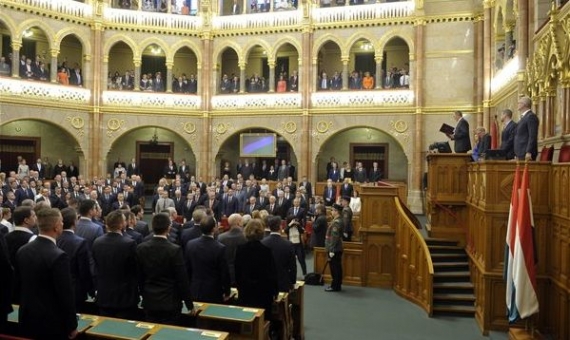
The Hungarian governing parties - that is, Fidesz and the small KDNP - re-elected János Áder, a former high-ranking official at Fidesz, as Hungarian President. None of the opposition members of parliament endorsed János Áder's candidacy.
In his annual 'state of the nation' speech, delivered traditionally in front of his followers, Hungarian Prime Minister Viktor Orbán said Hungary’s main task in 2017 would be fending off five major “attacks” against the country.
The Hungarian government has withdrawn with immediate effect from the international anti-corruption organization 'Open Government Partnership' as stated in a letter sent by the Hungarian Ministry of Foreign Affairs and Trade.
the government's proposal for changing Hungary's Basic Law (constitution)
Commemorations were held in Budapest on October 23 to mark the 60th anniversary of the popular uprising against the Stalinist regime in 1956. PM Viktor Orbán warned of the 'Sovietization' of the EU while the opposition called for him to be toppled.
For the first time in many decades, the Hungarian daily Népszabadság was not published this Monday. The publishing company, citing economic reasons, notified journalists on Saturday morning that they should not come to work on Sunday.
Only about 43,5% of the over eight million people eligible to vote cast a NO vote at a referendum to the government's question allowing EU quotas for migrants' settlement into Hungary, therefore, the result is invalid as the validity limit is 50%.