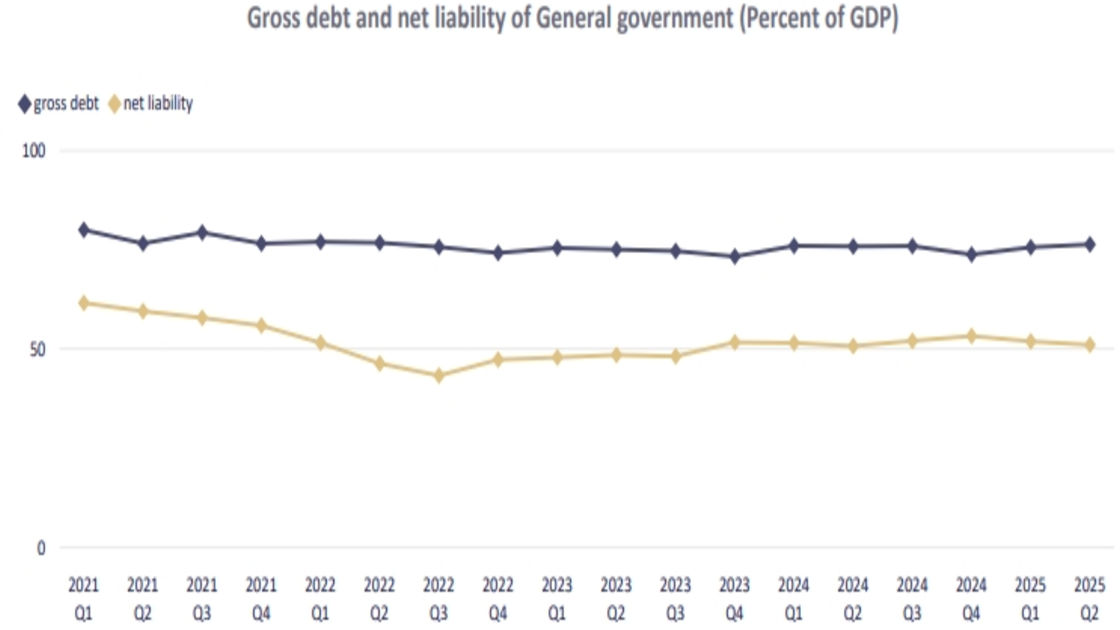

General government consolidated gross debt at nominal value was 76.0% of GDP, amounting to HUF 63,981 billion, at the end of 2025 Q2, according to data published by the National Bank of Hungary (MNB).
At the beginning of the year, the national debt stood at HUF 59,875.7 billion, which was 73.5% of the gross domestic product at the time. In other words, in the space of six months, the Hungarian state accumulated HUF 4,105 billion in debt, and the debt ratio rose by 2.5 percentage points.
According to preliminary financial accounts data, general government net lending was equal to -3.3% (HUF -2,804 billion) of Hungary’s GDP in the four quarters to 2025 Q2. According to preliminary financial accounts data, net lending of households was equivalent to 5.6% of GDP in the four quarters to 2025 Q2 (HUF 4,718 billion). The net financial worth of households reached 117.3% of GDP at the end of 2025 Q2.
General government net lending amounted to HUF 489 billion or 2.2% of quarterly GDP in 2025 Q2. Of the sub-sectors of general government, net lending of central government, local governments and the social security funds was HUF 508 billion, HUF -20 billion and HUF 1 billion, respectively.
At the end of 2025 Q2, the non-consolidated stocks of general government’s assets and liabilities amounted to 37.8% and 88.5%, respectively, of GDP. As a result, the sector’s net financial worth amounted to -50.7% of GDP.
Within financial assets of the general government, deposits with the central bank and rest of the world rose significantly due to transactions. The stock of loans granted also rose, while holdings of securities and shares fell due to transactions.
A sharp rise was seen in other accounts receivable, primarily in accounts receivable related to EU transfers. Within liabilities of the general government, there was a strong increase in securities due to transactions, which was mainly due to massive net purchases of government bonds by non-residents.
Financial institutions made net sales in 2025 Q2. A shift occurred in favor of long-term securities in the stock of securities of households. Loan liabilities of general government decreased due to transactions, and other liabilities also fell slightly.


Top 5 Articles
 What Awaits the Hungarian Economy in 2026 and 2027? April 24, 2026
 - Consolidating the Good Bilateral Relations May 10, 2026
- Business, Consumer Confidence at Two-Year High in April April 23, 2026
- Two Vantage Points, One Direction August 22, 2026
- Building Bridges in a Changing World March 26, 2026