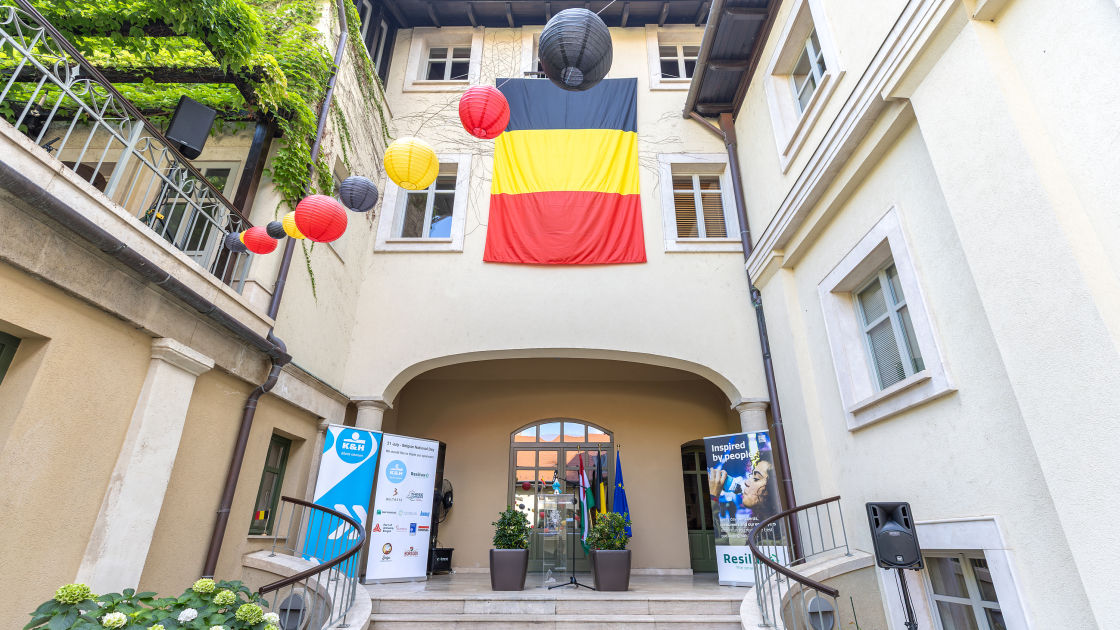

Having arrived in Budapest as the Ambassador of Belgium in August 2023, one of the perks I greatly enjoy is the location, beauty and rich history of the Belgian Residence, which I am privileged to live and work in. The residence is situated on Donáti Street 34, in the attractive historical First District at the bottom of the Buda Castle Hill.
I can easily climb the leafy stairs to reach Matthias’ Church and the Fisherman’s Bastion in ten minutes, while the Danube embankment on Batthyány Square with its splendid views on the House of Parliament across, is less than five minutes away. It offers Belgium a prestigious location from where Belgian-Hungarian relations can be strengthened in a credible and dignified way.
Historic background
The premises were acquired by the Belgian State on December 31, 1921, as formal diplomatic relations between Belgium and Hungary were established in 1922 after the collapse of the Austro-Hungarian monarchy. I am told that Belgium is one of the only countries whose pre-war Residence and Embassy in Budapest have never moved until this day. We are immensely proud of that and it underlines how happy and well-established we are in this neighborhood.
However, the history of the premises goes back much longer. The first owner of the estate is thought to have been a prestigious nobleman from Buda, József Ferenc Falk, the administrator of the Danube Shipping Chamber, who gained hold of the property in 1781. Later on, the stonemason family Hofhauser from Augsburg acquired the property and built one of the earliest residences. Antal Hofhauser, one of Budapest’s famous architects born in 1853, remembered visiting his grandfather’s house there. The current wing on Donáti Street was allegedly built between 1828-1830, the year of Belgium’s independence. The Hofhauser family sold the house in 1881. From then until 1919 (when the premises were briefly nationalized under the short-lived communist republic), the house had several owners and tenants, including high officials, lawyers, university professors, bankers and some famous personalities such as Béla Brunhuber, who became Archduke Joseph of Habsburg’s court photographer. Interestingly, from 1881, the building also housed the secretariat of the Hungarian National Shooting Club.
Belgian residence
In 1921, it was Belgium’s newly arrived envoy, Maximilien-Henri van Ypersele de Strihou, who chose the building as Belgium’s first Embassy in Budapest. From 1922, architect István Medgyaszay initiated a major reconstruction of the Donáti Street building and a new façade was built for the adjacent Toldy Ferenc Street entrance to the offices of the Embassy. Ambassador van Ypersele was succeeded by Vicount Jacques Davignon, whose son Etienne, who later became a prominent Belgian diplomat and Vice-President of the European Commission, was born in the residence. In fact, he was named after Hungary’s first king and spiritual patron, St Stephen. During the Second World War, when diplomatic relations were severed, Belgium’s premises were temporarily administered by the US, Swiss and ultimately Swedish Embassies. During the war, the building offered refuge to a number of Jewish families against fascist persecution. Fortunately, the building suffered only minor war damage, but a smaller reconstruction was necessary in 1947. During the events of 1956, Belgium’s chargé d’affaires Frédéric Collon reported that debris fell into the residence’s courtyard after a neighboring building had been bombed, also resulting in several windows being blown out, while a number of high officials and members of the Imre Nagy government and their families temporarily found refuge in the residence as the Revolution was crushed by Soviet troops.
A strong link
It is evident from all this that the Belgian Embassy Residence was not insulated from Budapest’s turbulent 20th century history. It is the reason why I have come to consider the building itself as a strong link between our two countries and a credible witness of the solid foundation of our relations of friendship and cooperation. Fortunately, the Embassy Residence has also served as the venue of countless joyous occasions, including colorful National Day celebrations, and the visits of not less than three Belgian kings, Their Majesties King Baudouin (in 1990), King Albert II (in 2002) and our current King Philippe (in 2000, in his capacity as Crown Prince, leading an important economic mission), as well as numerous politicians, diplomats, artists, academicians, students, journalists, civil activists and business leaders. A last thorough renovation and modernization of the residence and embassy compound was realized in 2007-2011 under Ambassador Pierre Labouverie. Minor adjustments have followed, including of the inner courtyard garden terraces which I enjoy embellishing, e.g. with an olive and fig tree as the most recent additions. The residence is listed as a historic building by the directorate of Hungarian national monuments due to its historic and artistic value.
The House of Belgium
Ever since its acquisition by the Belgian State more than a century ago, it has loyally fulfilled its duty as a stage for precious encounters, meaningful discussions and new initiatives, strengthening the cordial and long-standing bilateral relations between Belgium and Hungary, who are destined to remain strong partners in the European Union. We are ever so proud and grateful that so many Hungarian, Belgian and diplomatic guests have enjoyed attending numerous functions at the Belgian residence on Donáti Street, and I personally look forward to welcoming many more, after which my successors will take over, but the Residence will always remain the House of Belgium in Budapest.
(I am grateful for the historical research of Dr. Gergely Fejérdy and several of my predecessors)


Top 5 Articles
 What Awaits the Hungarian Economy in 2026 and 2027? April 24, 2026
 - Consolidating the Good Bilateral Relations May 10, 2026
- Cherishing Italian Cultural Presence in Hungary September 3, 2026
- Two Vantage Points, One Direction August 22, 2026
- Business, Consumer Confidence at Two-Year High in April April 23, 2026