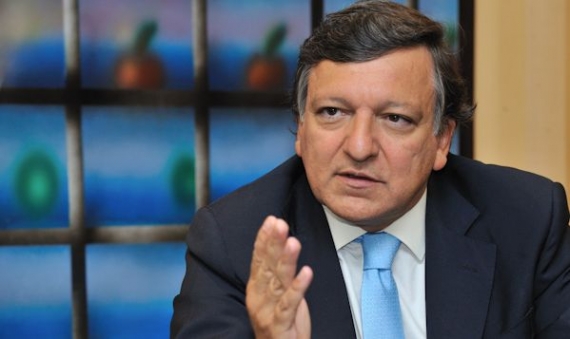

During the Hungarian Presidency, important steps have been taken to build a stronger European economy, said José Manuel Barroso in an interview given to eu2011.hu, on the occasion of the 9 May Europe Day. The President of the European Commission was looking forward to welcoming Croatia in the EU and to seeing the Presidency's report on the Roma strategy. Regarding the future of energy policy, he confirmed the Commission did not promote nuclear, and it was up to the Member States to decide on their energy mix. We have some excerpts from the interview.
"I sincerely believe that Europe is now on the right track – though the effects of the crisis will, unfortunately, be felt by many citizens and businesses around Europe for some time yet. The Commission is now predicting GDP growth of 1.8% for the EU this year, which is an upward revision compared to our autumn forecast. And the role of domestic demand in sustaining the recovery looks set to increase, which will help to make growth more balanced and sustainable."
"Europe has taken important steps forward during this Presidency, drawing lessons from the economic crisis and building a stronger European economy for the future. The biggest step has been the swift and substantial progress on the six legislative proposals on economic governance. Once this package is formally agreed, the euro area will have strong economic and budgetary coordination to complement the single monetary policy in place since 1999. The Economic and Monetary Union will finally walk on both legs."
"We have taken a big step forward under the Hungarian Presidency as regards the Roma strategy, with the setting up of an EU Framework on National Roma Integration Strategies for the period to 2020. I am looking forward to seeing the report on this that the Presidency will submit to the June European Council."
"Regarding our Neighbourhood Policy, Hungary has continued during its Presidency to press for deeper relations with our eastern neighbours. The countries of this region should seize the opportunity to accelerate domestic reforms which will help to bring them closer to the EU. In the case of Ukraine, I am pleased that there has been good progress in the talks on an ambitious new Association Agreement."
"On enlargement, there has been progress particularly as regards Croatia. I would like to make very clear that the Commission is looking forward to welcoming Croatia as the 28th EU Member State. Its EU accession is in sight, but a final effort is needed."
"Nuclear power currently provides around 30% of the EU's electricity, but that situation differs widely from country to country. The Commission does not promote nuclear: it is for Member States to decide on their overall energy mix and whether this should include nuclear."


Top 5 Articles
 What Awaits the Hungarian Economy in 2026 and 2027? April 24, 2026
 - Cherishing Italian Cultural Presence in Hungary September 3, 2026
- Consolidating the Good Bilateral Relations May 10, 2026
- Indotek Group Acquires 100% of Auchan Magyarország June 26, 2026
- Two Vantage Points, One Direction August 22, 2026