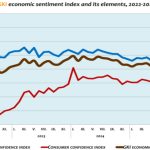
As expected, the Monetary Council of the National Bank of Hungary (MNB) left its policy rate unchanged at its meeting this Tuesday. In the explanatory statement, the central bank stresses the importance of caution in view of deteriorating external developments.
The press statement released after the meeting points out that MNB’s primary objective is to achieve and maintain price stability. Without prejudice to its primary objective, the MNB preserves financial stability and supports the Hungarian government’s economic policy, as well as its policy on environmental sustainability.
In 2024 Q3, economic growth is likely to have continued at a moderate pace in Europe. In the US, the labor market remained strong and the economy grew steadily. GDP growth slowed in China in the third quarter on an annual basis. There is uncertainty around future developments in European economic activity due to the prolonged weak outlook for industrial production, while the ongoing Russia-Ukraine war, the intensification of the conflict in the Middle East and the generally tense geopolitical situation remain key risks.
Inflation declined both in the euro area and in the US in September. Looking ahead, moderate inflation rates are expected as global economic demand remains subdued; however, the stronger price dynamics of market services is still restraining disinflation. Oil and gas prices increased sharply following the intensification of geopolitical conflicts, with a correction in global oil prices at the end of the period.
Risk aversion towards emerging markets has increased since the September interest rate decision as global investor sentiment deteriorated. This was mainly driven by the escalation of the conflict in the Middle East and the upward shift in expectations regarding the Federal Reserve’s interest rate path. The European Central Bank (ECB) lowered its policy rates by 25 basis points in October, and based on market pricing, expectations for the year-end level of the ECB’s interest rates remained broadly unchanged. In the CEE region, the Czech central bank reduced its policy rate by 25 basis points, and the Polish and the Romanian central banks left interest rates unchanged at their latest rate-setting meetings.
In 2024 Q2, the economic recovery stalled in Hungary. Household consumption picked up relative to a year earlier, and net exports also made a positive contribution to economic growth while investment declined significantly in the second quarter. In August, both industrial production and construction output fell compared to the same period last year, while the annual increase in the volume of retail sales continued, the statement says.


Top 5 Articles
 What Awaits the Hungarian Economy in 2026 and 2027? April 24, 2026
 - Cherishing Italian Cultural Presence in Hungary September 3, 2026
- Consolidating the Good Bilateral Relations May 10, 2026
- Two Vantage Points, One Direction August 22, 2026
- Business, Consumer Confidence at Two-Year High in April April 23, 2026