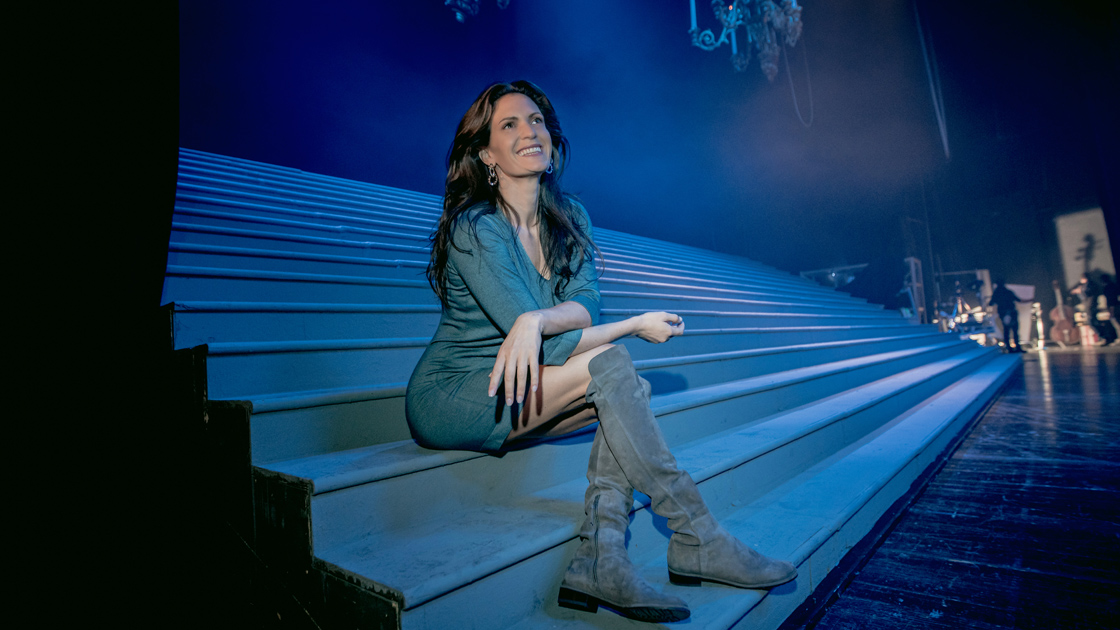

In a world that often treats career, family and love as competing forces, Andrea Bocelli’s wife and long-time manager speaks about them as parts of one architecture – a structure held together not by perfection, but by presence. For her, the point is not to “balance” three separate worlds, but to keep everything anchored to what she calls the essential: the people you love, and the concrete good you can generate.
At the center of that vision is motherhood – not as a private label, but as a daily compass. “Family and love are two different ways of saying the same thing,” Veronica Berti Bocelli says, describing them as the “we” built day by day. Motherhood, in her words, is the strongest motivation precisely because it continually brings her back to fundamentals: responsibility, time, and meaning.
That same logic shapes how she thinks about work. Rather than presenting career as self-expression alone, she frames it as opportunity plus duty – something that can stand firmly only if it remains connected to people and purpose. It’s a worldview that sounds almost diplomatic: values first, roles second; continuity over spectacle; substance over noise.
Beyond the legend: the private Andrea living
Being next to one of the most recognizable voices on the planet inevitably invites a public narrative – but Veronica insists the private story is simpler, and more instructive. “For me, first and foremost, he is Andrea,” she says, emphasizing the consistency between the man on stage and the man at home: the same seriousness, the same respect for craft, the same coherence of character.
What stands out most in her portrait of her husband is not celebrity, but temperament – calm, steady, rarely angry. Over time, she explains, that calmness has given their life equilibrium and even softened what she calls some of her own rigidity. In a partnership where choices can carry public and professional consequences, she describes him as more than a spouse: “my best friend and my first adviser,” especially at decisive moments.
It is a definition of strength that is quietly modern: not dominance, not performance but reliability – an “alliance,” as she calls it, that becomes a fixed point amid constant motion.
Femininity, complementarity and the discipline of the everyday
The public may see her in multiple roles at once: manager, wife, mother, supporter, public figure. She does not romanticize the complexity. Holding these dimensions together, she admits, is “truly complicated” at times – and the most honest risk is ending up doing everything “halfway.” Results can be “debatable,” she says with disarming self-awareness.
Still, her approach is not to retreat from responsibility, but to meet it with discipline and duty. Where some would talk about “having it all,” she talks about learning – daily – to choose, to show up and to accept the need to begin again.
Her view of femininity follows the same pragmatic line. She describes it less as aesthetic identity and more as awareness of women’s fundamental role in family and society – a role that includes strength, potential, and difference. Crucially, she frames this within the language of complementarity: distinct tasks and distinct “languages,” without confusion, without competition. Her greatest strength, she says, comes from everyday responsibility and a continuous search for equilibrium.
And if there is a single word that holds the structure together, it is the one she returns to repeatedly: harmony – not a passive state, but active work. A practice. A strategy.
Education as a public investment: protecting fragile talent
If the private sphere gives her the compass, the public sphere gives her a mission. Veronica Berti Bocelli speaks with particular clarity about supporting children and young people, shaped by an understanding that talent often appears early – and can also be fragile.
Supporting young people, for her, is not symbolic charity. It means building pathways that offer real formation, real opportunity, autonomy and dignity. It also means rejecting short-term gestures in favor of systems: ecosystems of quality that can be measured and replicated.
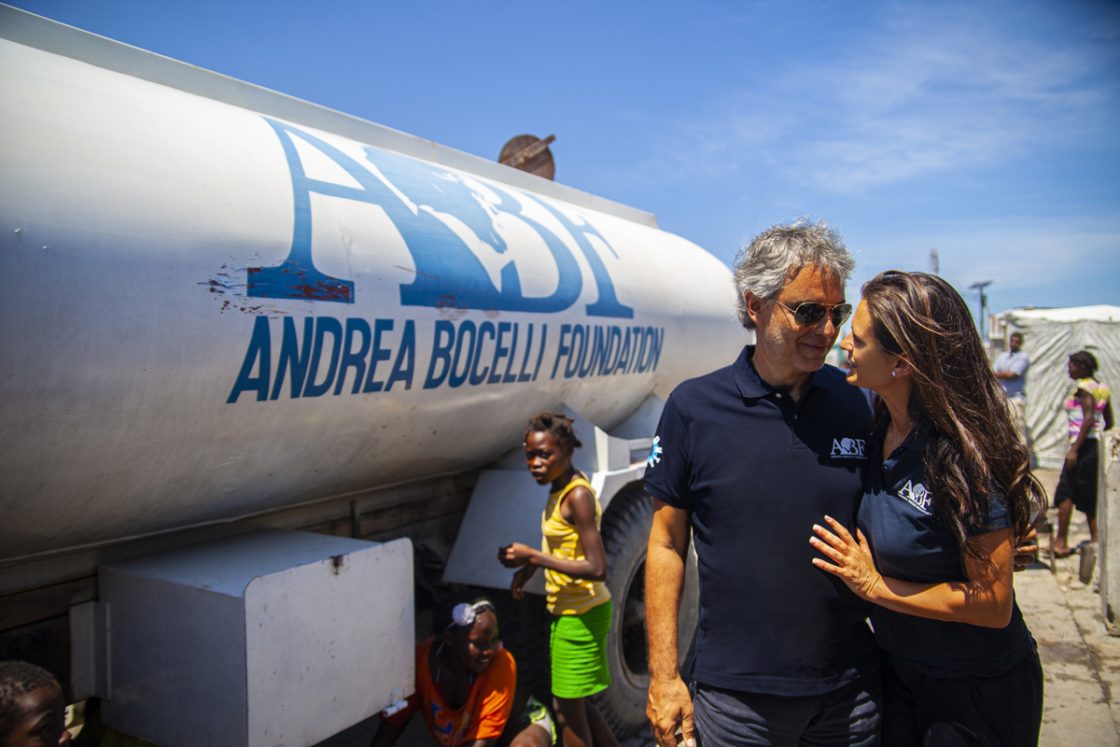
Within the work of the Andrea Bocelli Foundation (ABF), where she has been involved since its creation, this translates into education understood in the broadest sense – growth of the person as a whole, including dignity, confidence, hope and concrete prospects. The foundation’s mission, “Empowering people and communities,” becomes, in her description, a commitment to build environments where a young person can genuinely develop – and where the benefits spread beyond the individual.
It’s an argument that resonates strongly in today’s Europe: investing in children and young people is not only a moral act, but a form of rebuilding the present and shaping a more equitable, shared future.
Virtuosity and responsibility: when excellence leaves no easy choices
Her experience as a jury member on Virtuosos offered a different angle on talent: not its promise, but the ethical weight of evaluating it. What remained most memorable for her was the extraordinary level of the young musicians – so high that decisions were rarely about obvious gaps.
“You realize the choice isn’t between ‘good’ and ‘less good’,” she reflects, “but among truly gifted artists, with minimal differences.” In that environment, selection becomes an act of responsibility: choosing someone inevitably means leaving someone else behind.
Her contribution, she explains, was that of a manager – bringing an eye trained not only on artistry, but on the demands of professional trajectory: stage presence, communication and the responsibilities of public life. The human dimension mattered too, and she recalls a strong sense of harmony within the jury – including the personal privilege of sharing the experience with Plácido Domingo whom she describes as both admired and dear.
Music and love: the education of listening
Perhaps her most revealing perspective comes when she describes the relationship between music and love – not as metaphor, but as training. Love, she suggests, gives substance to what we want to say; music is one of the highest forms through which we can say it to others.
Then she moves from philosophy to practice by saying that music educates us in love because it educates us in listening. In choral singing, she notes – including projects at the heart of ABF’s “ABF Voices Of” – you learn to breathe with others, cooperate, support and be supported. In other words, music becomes a school of authentic relationship, and therefore of mutual responsibility.
“When music is true,” she says, “it creates bonds – it unites what life tends to separate – and it transforms encounter into growth.”
Hungary, a musical powerhouse with cultural memory
Her relationship with Hungary is long-standing, born of frequent returns for concerts over more than a quarter of a century. Over time, she says, a warm and genuine bond has formed with Hungarian audiences – one they feel each time they come back. Hungary, in her view, deserves its reputation as a musical powerhouse. Music here is woven into cultural life with a naturalness and discipline that are immediately recognizable – supported by a legacy of composers and performers who shaped history, and by the living continuity of study, performance and listening.
Beyond concert halls, she also highlights the wider cultural frame: the arts, natural beauty and a rich gastronomic world – the kind of context that stays in memory and turns return into affection and gratitude.
A quiet conclusion
Asked indirectly – as public figures often are – “how do you do it?”, she refuses any mythology. No recipes. No pretension of perfection. Only daily work: small choices, presence and the patience to start again. In an era hungry for fast answers, her approach feels almost countercultural: harmony as a discipline, not a slogan – and a life built not around the fear of the Bermuda Triangle, but around the steady decision to keep everything attached to what matters.


Top 5 Articles
 What Awaits the Hungarian Economy in 2026 and 2027? April 24, 2026
 - Consolidating the Good Bilateral Relations May 10, 2026
- Business, Consumer Confidence at Two-Year High in April April 23, 2026
- Long-Standing, Respectful Relations March 25, 2026
- Building Bridges in a Changing World March 26, 2026