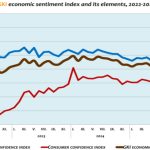

According to a survey conducted by the GKI Economic Research Co. – with the support of the EU –, public expectations improved significantly, to levels not seen in 5.5 years. The GKI Consumer Confidence Index increased by 16.1 points. Such a positive monthly shift has never been seen in the more than 30-year history of the index.
The May value of the index was -0.9 points, a higher value than which has only been measured in two periods so far: in the few months following the 2002 elections and in some months of 2018–2019. All this suggests that hopes regarding the future operation of the new government and confidence in the economic policy turnaround have strongly influenced public opinion.
The monthly increase is primarily due to the significant improvement in the country’s economic situation over the next 12 months and the financial prospects of the population over the next 12 months. The former sub-index increased by 33.4 points and the latter by 17.6 points in a single month. If we look at the past year, the former is 60.2 points higher and the latter is 28 points higher than 12 months earlier. Experience over the past 30 years shows that around parliamentary elections, index values are much higher than average, but there has never been a sudden improvement like the current one; in previous periods, the increase had been a much more prolonged trend.
The other two sub-indices of the index also moved in a positive direction, although to a more moderate extent than the previous ones. The population assessed their financial situation over the past 12 months as 6.4 points more favorable, while the development of their money available for spending on high-value consumer goods over the next 12 months was 7 points more favorable than at the beginning of April. The asymmetry of the sub-indices is instructive: households’ expectations for the future have moved much more than their assessment of their own financial situation over the past 12 months. This indicates that the current confidence jump reflects confidence in the economic policy turnaround rather than a rapid short-term change in the actual situation of households.
The population’s inflation expectations have decreased significantly – and to a lesser extent, the rate of monetary deterioration experienced over the past 12 months has also decreased – while the assessment of the expected development of the number of unemployed has improved significantly. Overall, the population assessed all factors related to the index and those outside it more favorably in early May than a month earlier. In fact, the data of the coming months will show whether the current jump is the beginning of a lasting trend reversal or a one-off peak in expectations related to the change of government.


Top 5 Articles
 What Awaits the Hungarian Economy in 2026 and 2027? April 24, 2026
 - Consolidating the Good Bilateral Relations May 10, 2026
- Two Vantage Points, One Direction August 22, 2026
- Building Bridges in a Changing World March 26, 2026
- Business, Consumer Confidence at Two-Year High in April April 23, 2026