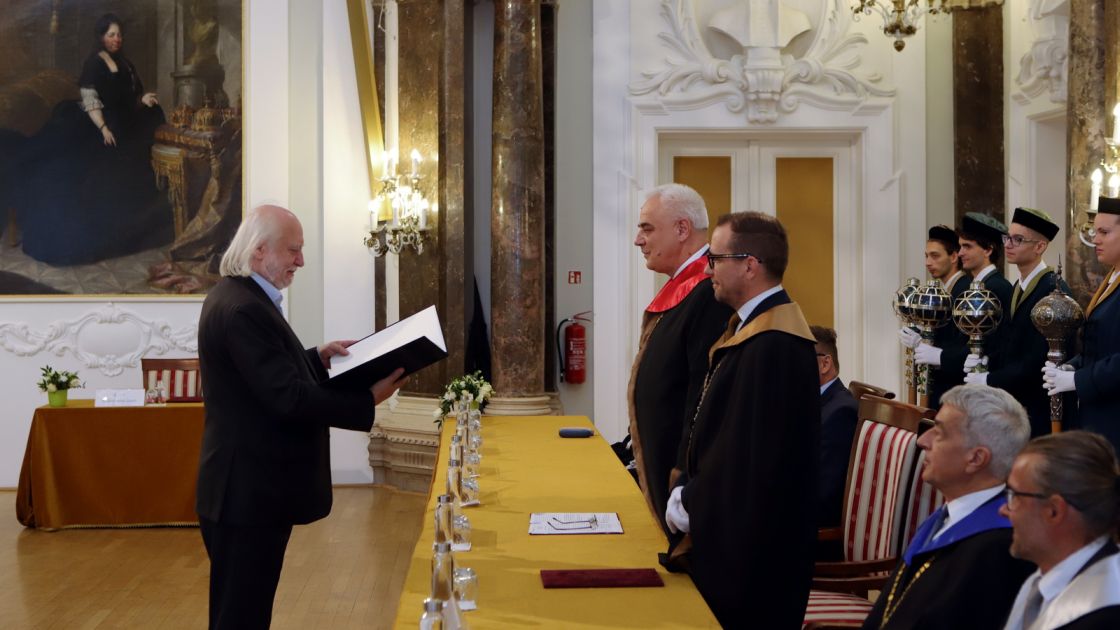

Hungarian author László Krasznahorkai, the winner of last year's Nobel Prize in Literature, has received the Doctor Honoris Causa title of Budapest's Eötvös Lóránd University.
László Krasznahorkai is truly deserving of the university’s highest honor, based on his body of work, which enriches universal culture with enduring values, and his internationally outstanding achievements, according to Rector Lénárd Darázs who spoke at the ceremonial general assembly for the conferral of an honorary doctorate at ELTE.
He added that the artist had been nominated for the title of Doctor Honoris Causa by ELTE’s Faculty of Humanities, and that the Senate had awarded it with unanimous enthusiasm.
In László Krasznahorkai’s works, moral sensitivity, a philosophically profound interpretation of human existence, and the exceptional aesthetic power of his portrayal form a unity that makes his body of work highly influential and of epoch-making significance,” said Dávid Bartus, dean of the Faculty of Humanities at Eötvös Loránd University, in his tribute to the writer.
He explained that László Krasznahorkai’s works portray with exceptional power humanity’s frailty and vulnerability, as well as its fateful attraction to decay. His novels and short stories, meanwhile, offer a sharp critique of the modern era’s growing indifference toward higher values – that intellectual and emotional shallowness, which is emptying our world of meaning.
The tone of his epic works is defined by a profound sadness felt in the face of destruction and decay, the dean emphasized, adding that ethics and aesthetics are closely intertwined in his body of work, because respect for beauty is, in fact, a moral stance against the indifference that has become almost universal.
He noted that the works of the world-renowned Hungarian writer have been translated into more than 40 languages; in addition to domestic honors, he has received numerous international accolades, and in 2025, he was awarded the Nobel Prize in Literature.
László Krasznahorkai expressed his gratitude for the recognition. In his speech, he spoke about the universal whole, understanding the world, hopelessness, everyday reality, and the collapse of the imagination. He explained how his journey took him from an interest in the universe, through a return to the human, everyday world, to a deep, formless disillusionment.


Top 5 Articles
 What Awaits the Hungarian Economy in 2026 and 2027? April 24, 2026
 - Consolidating the Good Bilateral Relations May 10, 2026
- Cherishing Italian Cultural Presence in Hungary September 3, 2026
- Two Vantage Points, One Direction August 22, 2026
- Business, Consumer Confidence at Two-Year High in April April 23, 2026