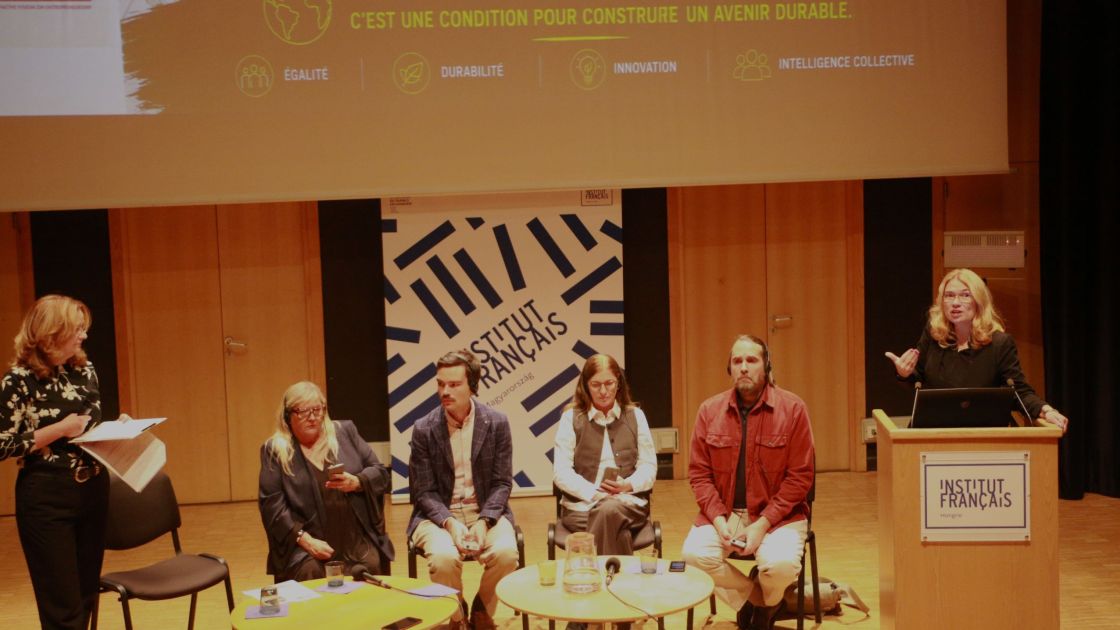

At the Global Five 2026 conference, organized by ESSCA Budapest on October 5, 2026, at the French Institute, participants analyzed the challenges faced by women in senior leadership positions, how growing inequalities affect women’s roles and opportunities, and to what extent they can incorporate the impacts of environmental change into their strategies and day-to-day activities.
Climate change not only threatens the future of the planet but also exacerbates social inequalities. Women are disproportionately represented among the most vulnerable. According to the UN’s worst-case climate scenario, as many as 158 million women and girls could be living in extreme poverty by 2050.
For ESSCA, which ranks highly in the Financial Times’ management education rankings and holds the “Triple Crown” accreditation, representing the pinnacle of the profession, sustainable development is not a new topic. The institution was among the first to integrate sustainability considerations into its educational portfolio. In line with this approach, Global Five 2026 examined how future professionals can be prepared for an economic and social environment shaped simultaneously by climate change, technological advancement, and social transformation.
In the days leading up to the conference, ESSCA Budapest and the authors of the volume also presented the completely revised university textbook ‘Tourism Marketing Case Studies III’, edited by Prof. Dr. Zsuzsa Deli-Gray, director and professor at ESSCA’s Budapest Campus. The publication traces the changes in the Hungarian tourism industry over the past 16 years through real-world market scenarios, and several of its studies also focus on the issue of sustainability.
The first volume of the series was published in 2010 with the aim of enabling students to master marketing theory through the real-life decision-making situations of specific players in the Hungarian tourism industry, rather than through international, fictional cases. Following the second edition, published in 2017, this third volume now reflects the changed consumer, technological and economic environment.
According to Prof. Dr. Zsuzsa Deli-Gray, the goal of the third edition is no longer simply to present current examples, but also to foster independent analysis and practical problem-solving.
“Since 2010, across three editions, we have tracked how the world of tourism is changing, and the book itself has evolved continuously in the process. In the third edition, in addition to current case studies, we have incorporated theoretical frameworks and the identification of different perspectives to encourage students to engage in independent analysis and practical problem-solving,” she said.


Top 5 Articles
 What Awaits the Hungarian Economy in 2026 and 2027? April 24, 2026
 - Cherishing Italian Cultural Presence in Hungary September 3, 2026
- Consolidating the Good Bilateral Relations May 10, 2026
- Two Vantage Points, One Direction August 22, 2026
- Business, Consumer Confidence at Two-Year High in April April 23, 2026