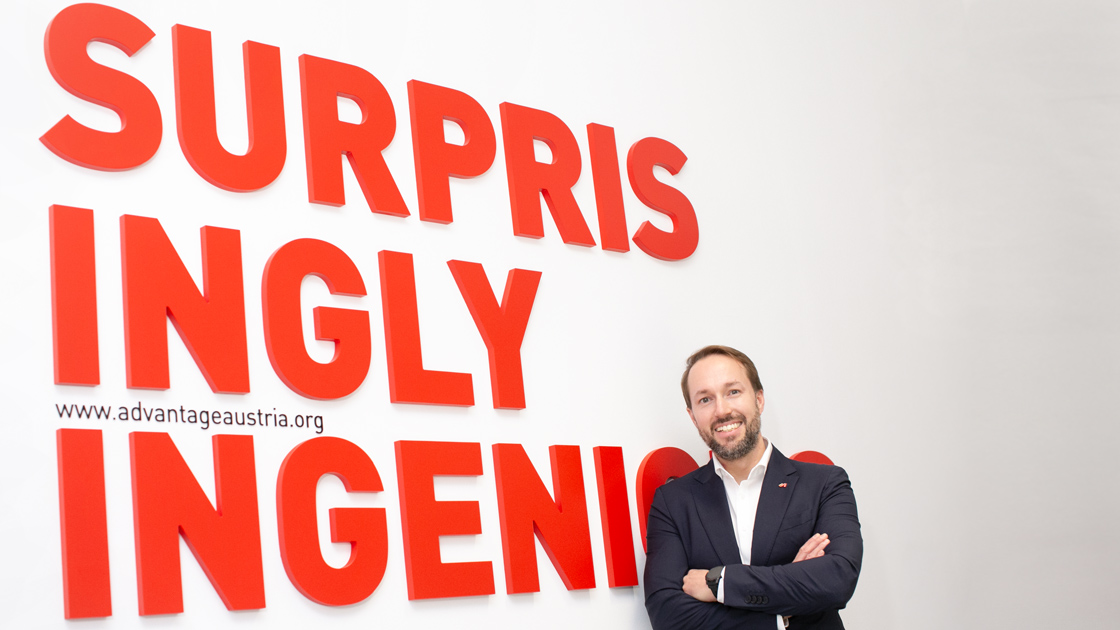

Austria has long been one of Hungary's most important economic partners and investors. Following the April election in Hungary, a spiking interest of Austrian companies in the Hungarian market has been observed, giving further foundation for the development of bilateral business relations.
The connection between Hungary and Austria has been very strong over a long period of time and still is. Austria is Hungary’s fourth most important trading partner and its second largest investor here with over 1,400 subsidiaries. Hungary remains among the top ten export destinations of Austrian products with around EUR 7 billion every year. That is how the Commercial Counsellor at the Austrian Embassy in Budapest, Philipp Schramel summarizes for Diplomacy&Trade the business relations between the two neighboring countries.
“What has been inspiring to experience, is how deeply Austrian businesses have been embedded in Hungarian economy – so much so that they are perceived as Hungarian by the Hungarian population. In many cases, executives of Austrian companies took their first professional steps in Hungary. For example, the current CEO of Rauch was sent to Hungary when he was 26 years old to build the company’s local presence. Many Austrian subsidiaries, established after the political transition, were built together with Hungarian partners, and today many of the people involved still hold management positions in Hungary and also as board members of the Austrian headquarters.
This illustrates that the Austrian-Hungarian connection goes far beyond Sissi and the Austrian-Hungarian monarchy. The economic connections are built on long-term partnerships and personal connections that have been developing over decades,” he highlights.
EU funding as market booster
Philipp Schramel is also the head of the trade promotion organization ADVANTAGE AUSTRIA Hungary and as such, he is in constant contact with business leaders. As to what the biggest opportunities – and the biggest concerns – these leaders raise when looking at the Hungarian market today, he highlights that every year, they conduct a survey, the Global Business Barometer, among the Austrian subsidiaries on the business climate in Hungary. The main concern of Austrian Subsidiaries are the challenging geopolitical developments. This includes not only developments in Hungary or Austria but also Europe’s overall position in an international environment. “The main concerns within Hungary are the predictability of economic policy and the legal environment, the availability of skilled labor and rising labor costs. As an opportunity there is a notable sense of optimism across Hungarian citizens, local companies and Austrian investors following the April election. We have observed a spiking interest of Austrian companies in the Hungarian market over the summer. As soon as the EU funds start flowing in and the programs and projects are launched, we expect even stronger dynamics in the market.”
Nearshoring opportunities
Supply chains have become much more regional since the new coronavirus pandemic and due to recent geopolitical tensions. The Commercial Counselor is of thew view that this created new opportunities for Central Europe and expects Austria and Hungary to strengthen their role as an integrated manufacturing and innovation hub.
He says nearshoring (i.e. the regionalization of supply chains) has created new opportunities for central Europe. Companies focus more on resilient supply chains, proximity to markets and shorter delivery times. Particularly in response to the current geopolitical situation, the pandemic and the war in Ukraine, for example, showed how vulnerable global supply chains and energy routes can be. “Austria and Hungary are well positioned to benefit. Hungary provides a strong manufacturing base while Austria contributes technology, engineering expertise and innovation. Creating potential for cooperations in e-mobility, battery technologies, artificial intelligence and advanced manufacturing. In fact, these developments were a key topic at this year’s Austrian Connect CESEE conference – the biggest Austrian regional event – in the Slovak capital Bratislava, our networking and information platform for Austrian companies, investors and business leaders.”
Strong potential for cooperation
Sustainability is increasingly influencing investment decisions from GreenTech to circular economy solutions and energy efficiency. As to where he sees the strongest potential for Austrian Hungarian cooperation in supporting the green transition, Philipp Schramel emphasizes that there is a strong potential for Austrian-Hungarian cooperation in energy-efficient buildings, renewable energy – particularly solar and wind power –, resource management as in reuse and recycling of raw materials, sustainable procurement and waste management. Hungary, as it follows climate transition goals can profit from Austria’s role as an international hub in green technologies and energy efficient construction.
“Today, however, one cannot discuss sustainability without taking the current geopolitical situation into account. Sustainability is a competitiveness and security issue in addition to an environmental one. Energy security, secure supply chains and resource efficiency are getting prioritized, which makes cooperations in those areas even more relevant. These topics were at the center of Build'n Green 2026, an international conference and B2B cooperation platform organized by ADVANTAGE AUSTRIA,” he adds.
Welcoming innovative and new ideas
Competitiveness has become one of Europe's defining challenges. Austria, Hungary and the EU must have their priorities to ensure that European companies remain globally competitive in an era of rapid technological change and intensifying international competition.
According to the Commercial Counsellor, in order to improve competitiveness, the European Union needs to provide an environment that is welcoming to innovative and new ideas. “First a focus should be on closing the innovation gap, European companies face a more complex regulatory environment than other global competitors. Supporting the adoption of new technologies, especially regarding AI and robotics inside companies, can help with boosting innovation. Second, simplifying rules and laws for a friendlier and easier environment for businesses to start and grow will be a key factor in improving competitiveness. Reducing bureaucracy and red tape for companies on a national and European level is a key demand of the Austrian Federal Economic Chamber. Thirdly, it is important to shift to clean and affordable energy and decarbonize our economy. This can be achieved for example by tailor-made action plans focusing on reducing energy prices and costs. Lastly it is important to reduce dependencies. Especially in the current geopolitical situation, secure supply chains are gaining more importance, while contributing to stronger competitiveness,” he points out.
Foundation for further cooperation
Philipp Schramel’s vision for the next five years is a stronger Hungarian economy, with Austrian companies continue contributing to and benefiting from this cooperation.
“It would be nice to see Hungary further transform from being perceived as an extended manufacturing base for Western Europe into a dynamic part of the European value chain, creating more value locally and attracting further investment,” he notes, adding that Austria and Hungary are already well positioned to achieve this together. Their close economic ties, geographic proximity and supply chains provide a foundation for further cooperation.
“Next year, ADVANTAGE AUSTRIA will mark 75 years in Hungary, and in five years we will celebrate our 80th anniversary. Over these past years, we can look back at countless success stories of Austrian-Hungarian cooperation. We look forward to encounter many more of these inspiring success stories in the years to come and to watch the economic relationship between Hungary and Austria grow,” he concludes.


Top 5 Articles
 Cherishing Italian Cultural Presence in Hungary September 3, 2026
- Indotek Group Acquires 100% of Auchan Magyarország June 26, 2026
- Ágnes Forsthoffer, Interim Hungarian President July 20, 2026
- Two Vantage Points, One Direction August 22, 2026
- Sziget Must 'Move Forward to Break Free' August 16, 2026