

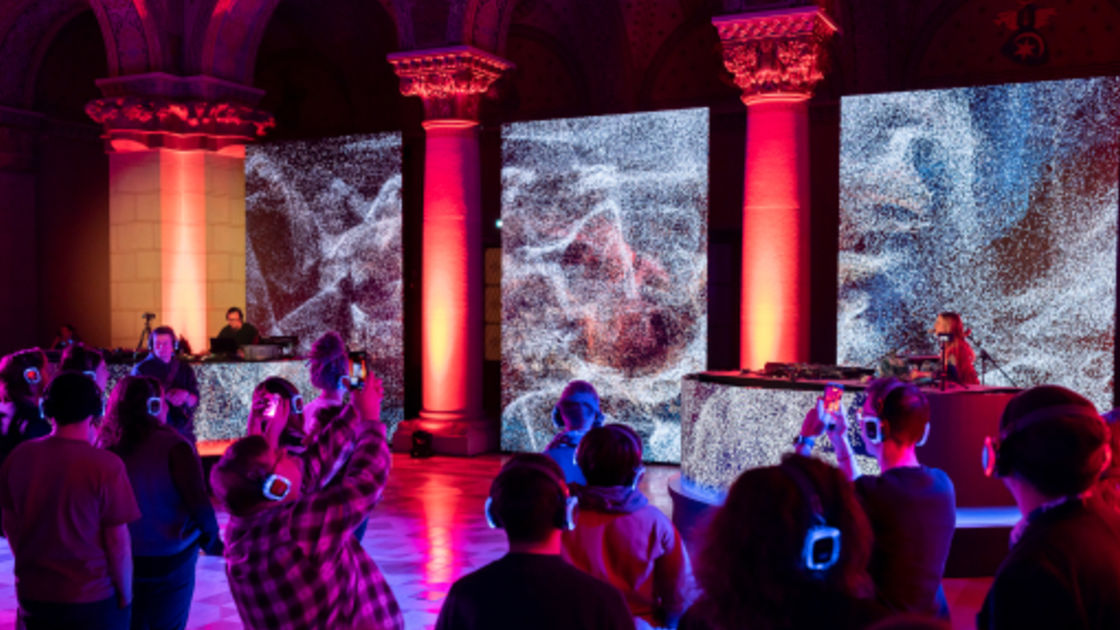

The Museum of Fine Arts bid farewell to the highly successful exhibition Heaven and Hell: William Blake and His Contemporaries with an extraordinary event: on the evening of January 10, it brought Blake's visions to life with a silent disco closing program. This unique event offered visitors a special experience at the intersection of fine art, literature and contemporary electronic music.
The silent disco format itself is rare in a museum setting, especially in the company of a body of work as historically and symbolically significant as that of William Blake. The music channels, which could be listened to through wireless headphones, allowed participants to connect simultaneously, yet in a personal way, to Blake's mystical universe — the tension between heaven and hell, order and chaos, rationality and vision.
Throughout the evening, several DJs took turns representing different musical worlds: ambient and experimental electronica, slow, meditative soundscapes, and darker, pulsating rhythms could be heard simultaneously. Visitors were free to switch between channels, “amplifying” Blake’s iconic ideas and images according to their own interpretation.
In an international context, the closing event of the Museum of Fine Arts fits into a trend in which major museums — leading institutions in London, Berlin, and Paris — are increasingly opening up to contemporary music and performance genres. Silent disco as a genre is particularly well suited to respecting the intimacy of the exhibition space while also appealing to new audiences.
The evening of January 10 was not only the closing of an exhibition, but also a kind of transition: between past and present, art and music, contemplation and participation. Blake the Silence silent disco was a fitting conclusion to the intellectual and emotional journey that the exhibition offered to the nearly 70,000 visitors who saw it between late September and early January — and a reminder that Blake's ideas are still alive, provocative, and inspiring today.
"Blake's visions and fantasy world were so groundbreaking in their time that we felt this was the best opportunity for the Museum of Fine Arts to bid farewell to this highly successful exhibition with a special event aimed at young people," Péter Polgár, head of corporate relations at the Museum of Fine Arts – Kultúra 2008 Nonprofit Ltd. pointed out. "We are delighted that the initiative was so well received by the public and that the exhibition was able to bid farewell with a sold-out event," he added.
The main sponsor of the event, Provident Ltd. has been present in Hungary for 25 years and has been a committed supporter of cultural and community value creation since its inception. By supporting the silent disco, the IPF English group company not only stood behind an outstanding artistic event, but also encouraged dialogue between past and present, international and domestic cultural traditions through contemporary forms. "This year, as we celebrate a quarter of a century of presence, our company will focus even more on appreciating local communities and our employees. We are grateful to both our customers and our colleagues for their trust, and we will celebrate this relationship based on trust with various events and our social responsibility programs. The first step in this direction was Blake the Silence," Provident CEO Viktor Boczán emphasized.


Top 5 Articles
 Duna House Profit Climbs Nearly 70% in Q3 November 24, 2025
  'Recharge' Campaign Launched to Boost Domestic Tourism January 21, 2026
  Richter Earnings Slip as Financial Loss Weighs November 6, 2025
  Asiana Airlines to Launch Direct Seoul-Budapest Flight October 31, 2025
  Genius Automotive Hungarian Subsidiary's CEE Expansion November 2, 2025

