
When determining the sovereign ratings, the credit rating agencies also consider the World Bank’s World Governance Indicators (WGI), albeit with different weights. The WGI examines six institutional areas: freedom of speech and accountability, political stability, government effectiveness, regulatory quality, rule of law, and the development of corruption control. GKI Economic Research Institute examined how these indicators have changed in the Visegrád countries and Romania since 2010.
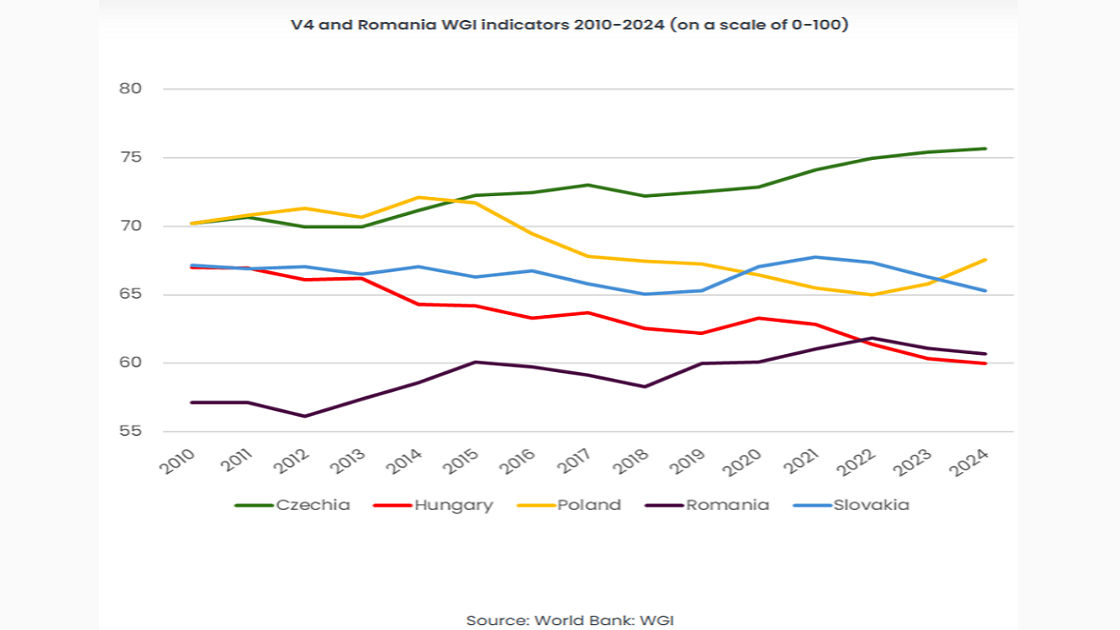
The research study points out that V4 and Romania provide a good basis for comparison to assess Hungary’s past performance, as these countries have similar economic development and historical trajectory. Based on the composite WGI, in 2010, Hungary and Slovakia both scored 67 points, while the Czech Republic and Poland achieved values around 70 points. Romania was still significantly behind at that time, at 57 points.
Hungary overtaken since 2010
In the decade and a half that have passed since then has shown dramatically different trajectories. While the Czech Republic has shown continuous improvement, Hungary has gradually regressed, and by 2024 the Hungarian indicator had already slipped below Romania’s level.
Hungary’s overall index decreased by seven points between 2010 and 2024. The largest decline occurred in the freedom of speech and accountability indicator (-17 points), but regulatory quality also deteriorated significantly (-9 points). Slovakia, on the other hand, showed only a moderate two-point decrease, while its rule of law indicator even improved. In Poland, the index deteriorated from 2016, primarily due to weakening political stability, but an improvement is visible again from 2023.
Romania showed the greatest progress in government efficiency and anti-corruption, which proved sufficient to overtake Hungary by 2024, despite an initial 10-point deficit, GKI highlights.


Top 5 Articles
 What Awaits the Hungarian Economy in 2026 and 2027? April 24, 2026
 - Consolidating the Good Bilateral Relations May 10, 2026
- Cherishing Italian Cultural Presence in Hungary September 3, 2026
- Two Vantage Points, One Direction August 22, 2026
- Business, Consumer Confidence at Two-Year High in April April 23, 2026