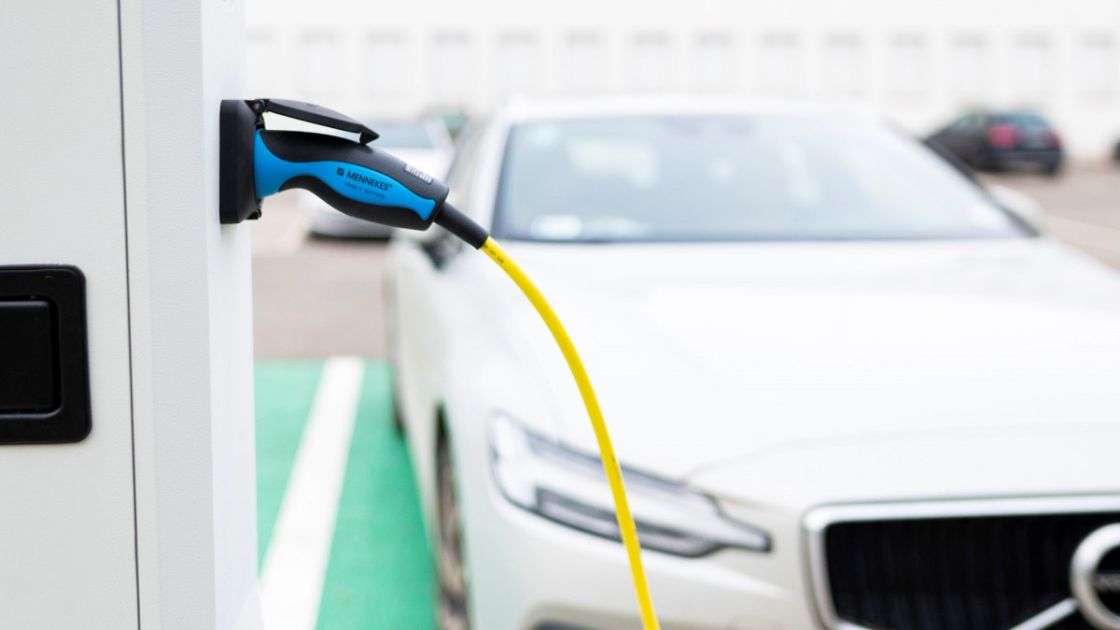

Budapest Airport, the operating company of the Hungarian capital's Ferenc Liszt International Airport, successfully applied for the European Union’s support program with its AIR-PRON project, which aims to make ground handling operations more sustainable and reduce carbon dioxide emissions, by developing the electrical power supply and charging infrastructure, the operator company says on its website – a long with the news that airport’s e-charging infrastructure has been expanded with EU support.
As part of AIR-PRON project, 15 fixed ground power units will be installed on existing stands, to serve passenger and cargo aircrafts, and 17 pre-conditioned air supply systems will be installed on passenger boarding bridges (the key feature of the latter is that air quality is regulated not by the aircraft itself, but by a ground-based system that consumes less energy and is more environmentally friendly). In addition, four electric charging stations for ground service equipment, each with a capacity of 100 kW, will be installed, enabling greener and more efficient ground handling.
Design works began in the first quarter of 2026, with construction expected to be completed in the second quarter of 2028. The European Union is providing a 50% grant for the project.
Regarding the airport’s e-charging infrastructure, the statement highlights that e-mobility is a key pillar of the sustainability strategy for Budapest Airport, part of the VINCI Airports network. Therefore, the airport operator has for years placed a strong emphasis on expanding its electric vehicle fleet and building an e-charging network, both inside and outside the airport perimeter. In 2022, Budapest Airport submitted its “Net Zero Airport” project to the European Union’s CEF 2 Transport – Alternative Fuels Infrastructure Facility grant program, under which a grant agreement was signed for the installation of 83 charging stations and 102 charging points. The charging stations were installed within the airport perimeter and can be used not only by vehicles belonging to the airport operator’s fleet, but also by partner companies operating at the airport.
The infrastructure built as part of the project supports numerous stages of the aircraft handling process; it can provide charging for trucks supplying in-flight catering, water and lavatory service vehicles, baggage handling vehicles and other air cargo handling vehicles, as well as for apron passenger buses, boarding stairs and tow vehicles.
The amount of European Union funding covers half the cost of constructing the 83 charging stations and the related infrastructure. Budapest Airport funded the other half of the project from its own resources.
Budapest Airport installed its first charging station in 2015 and purchased its first electric car in 2016; it currently operates 170 electric vehicle charging points and has 39 electric and 48 plug-in hybrid cars in its fleet.


Top 5 Articles
 What Awaits the Hungarian Economy in 2026 and 2027? April 24, 2026
 - Consolidating the Good Bilateral Relations May 10, 2026
- Cherishing Italian Cultural Presence in Hungary September 3, 2026
- Two Vantage Points, One Direction August 22, 2026
- Business, Consumer Confidence at Two-Year High in April April 23, 2026