
The previous government has treated the situation of Hungarian families, especially families with multiple children, as a priority since 2010. This also brought about a paradigm shift, shifting to a policy that encourages childbearing and aims to achieve demographic goals, in which they emphasized the role of work alongside the family. This resulted in a change in the structure of family support, with tax refunds and credits increasingly becoming the main means of supporting families, instead of individual benefits, thus making work a prerequisite for support, GKI Economic Research Co. says in its latest analysis.
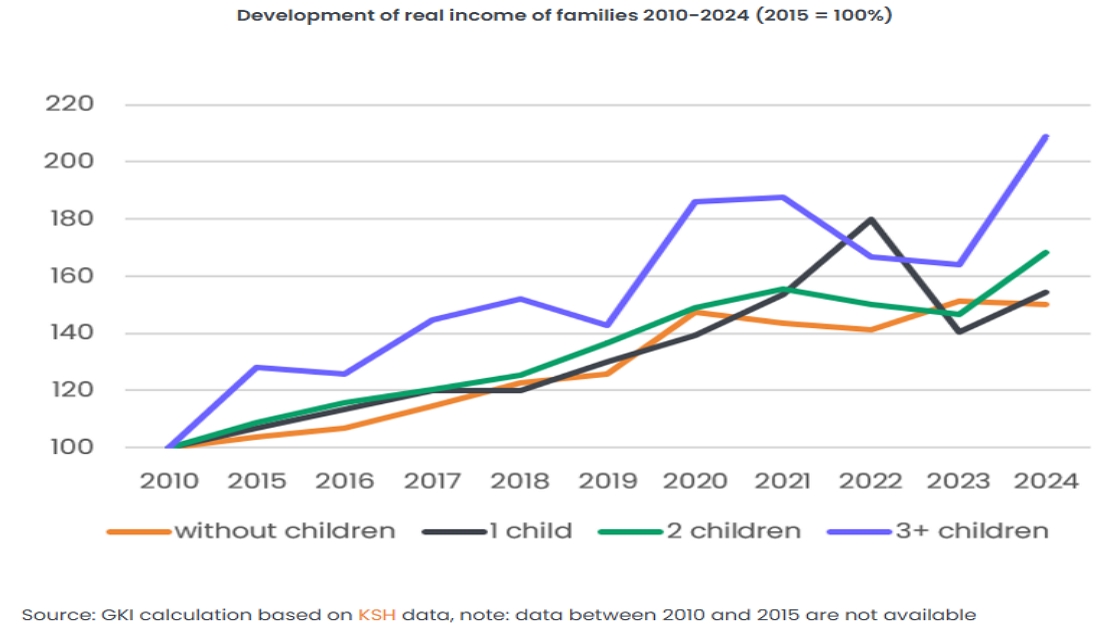
According to the Central Statistical Office (KSH), since 2010, family income has shown a significant increase, even adjusted for inflation. Their real incomes have increased by an average of 70% since 2010. However, as the support system for families increasingly supported those with more children – for example, the family tax credit, tax exemption for mothers with 4 or more children, GYET (extra childcare allowance above 3 children), the possibility of paying benefits together , and the doubling of the tax credit for those with two children – the real income of families with 2 or more children showed the greatest increase: the former increased by 108 percent and the latter by 68 percent compared to 2010. The real income of those without children and families with one child increased to a slightly lesser extent, by 50-54%.
GKI researchers point out that large-family focus of subsidies – such as tax breaks, preferential or non-refundable subsidies – also played a role in this lag. The subsidy calculated per child was higher for families with multiple children – thus encouraging having children – while the family costs calculated per child decrease with more children. Meanwhile, the non-insurance (work)-related family allowance and GYES (childcare allowance) gradually lost their value. While the family allowance accounted for 17-20 percent of per capita income in 2010 – depending on the number of children, in 2024 this value was only 6-8%. Similarly, the value of GYES also decreased: the per capita benefit decreased from 37% to 17% for those with one child. In addition, it is important to note that the nominal value of the tax refund-based subsidy increases with income, so under the discount ceiling, a higher-earning employee receives more discounts than a lower-earning colleague, while a higher amount would be of greater help to the latter.


Top 5 Articles
 What Awaits the Hungarian Economy in 2026 and 2027? April 24, 2026
 - Cherishing Italian Cultural Presence in Hungary September 3, 2026
- Consolidating the Good Bilateral Relations May 10, 2026
- Two Vantage Points, One Direction August 22, 2026
- Business, Consumer Confidence at Two-Year High in April April 23, 2026