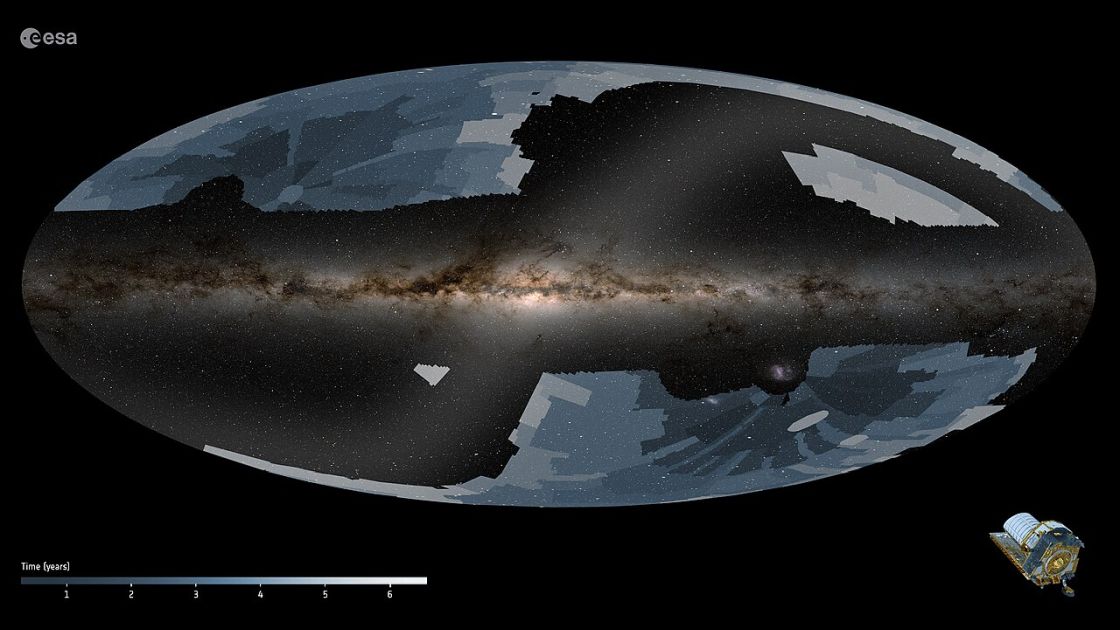

The Euclid space telescope has mapped over 60 million stars in the heart of the Milky Way, with Hungarian researchers playing a key role in the survey, the HUN-REN CSFK Konkoly Thege Miklós Astronomical Institute said on Wednesday, MTI reports.
The mission's data extends beyond cosmology, András Kovács, a researcher at HUN-REN's Konkoly Thege Miklós Astronomical Institute and leader of Hungary's Euclid team, said. "Euclid's chief aim is mapping the large-scale structure of the universe, but we're already seeing its broader applications – from charting the Milky Way to studying exoplanets," he added. The team is also working on unravelling the mysteries of dark matter and dark energy.
The European Space Agency's (ESA) Euclid telescope captured the most detailed survey to date of the galaxy's central region in visible light. In just 26 hours of observation in March 2025, it produced a mosaic image covering 4.8 square degrees of the sky, an area notoriously difficult to study due to its extreme density of stars.
The Euclid mission marks a milestone in exoplanet research using gravitational microlensing. The high stellar density at the galaxy's core makes it ideal for detecting planets orbiting other stars. While this observation did not directly detect new microlensing events, it provides uniquely precise data for future discoveries. The telescope's images separate individual stars far more clearly than most ground-based observations, enabling scientists to refine interpretations of future events and improve mass estimates for around 60 known exoplanets, including some as small as Mars.
The data, part of the Euclid Galactic Bulge Survey (EGBS), will serve as a reference point for NASA's upcoming Nancy Grace Roman Space Telescope, set to launch in August 2026. The Roman telescope is expected to discover over 1,000 new exoplanets in the same region using gravitational microlensing.
The findings, including images and datasets, are now publicly available to the global research community. With Euclid's main sky survey ongoing, scientists are preparing for the next major data release in November 2026, which will include observations from its first year and offer Incomparable insights into the evolution of galaxies, quasars and the universe itself.


Top 5 Articles
 What Awaits the Hungarian Economy in 2026 and 2027? April 24, 2026
 - Cherishing Italian Cultural Presence in Hungary September 3, 2026
- Consolidating the Good Bilateral Relations May 10, 2026
- Two Vantage Points, One Direction August 22, 2026
- Business, Consumer Confidence at Two-Year High in April April 23, 2026