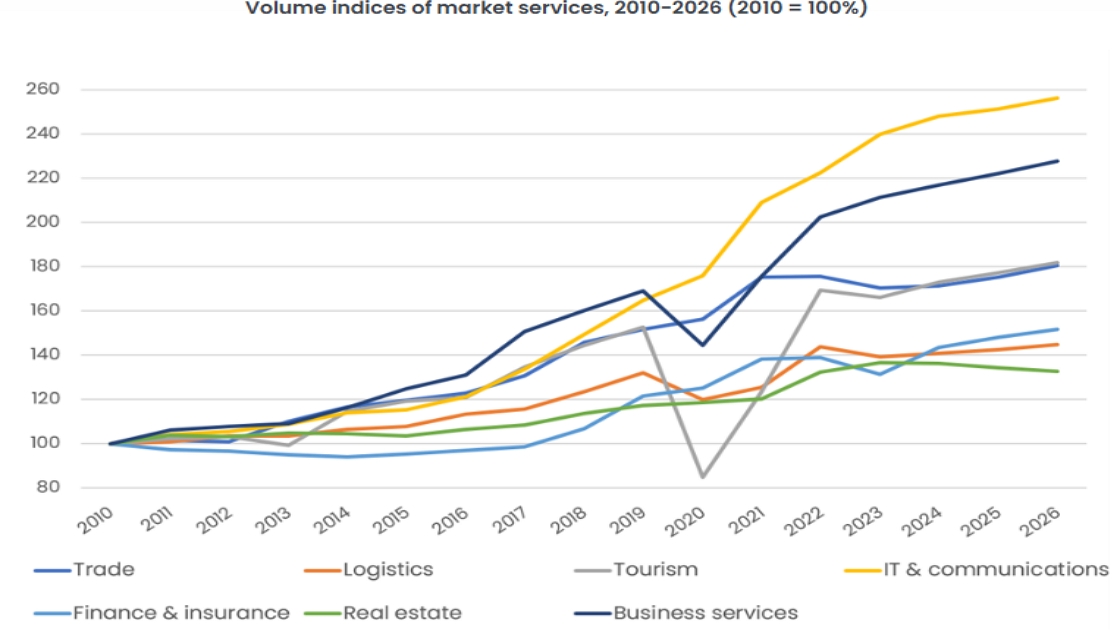

Volume of market services expanded around 60% in the period between 2010 and 2026, outpacing the 20% growth of the other sectors of Hungary's economy, an analysis by economic research institute GKI shows.
Within market services, the ICT sector expanded the most during the period (156%), followed by business services (127%), driven by digitalization and cloud-based services.
The volume index of trade increased by 75% until 2021, and since then the growth has slowed down (+5%). Here, the government price freeze and mandatory sales (“dismissed” by the EU court), as well as the margin freeze, which is currently under litigation, have pushed back the volume growth, and regulations on shopping malls have not helped the sector either. The intensification of foreign competition (e.g. Temu, Shein) in the sector causes a special problem. However, the strengthening of the forint is favorable for the sector due to cheaper imports than domestic production.
In the tourism sector (+81% since 2010), the dynamic growth trend experienced before 2019 has slowed down due to the new coronavirus epidemic, but the expansion is supported by the SZÉP card system and increasing real wages. However, the strong forint is holding back (more people are traveling abroad, and fewer people are coming to our country).
Other market services showed only moderate volume growth of around 35-50%. Logistics [2]is constrained by external shocks to supply chains, while growth in the financial sector was held back by strong taxation, GKI said.


Top 5 Articles
 Cherishing Italian Cultural Presence in Hungary September 3, 2026
 - Consolidating the Good Bilateral Relations May 10, 2026
- Indotek Group Acquires 100% of Auchan Magyarország June 26, 2026
- Two Vantage Points, One Direction August 22, 2026
- Ágnes Forsthoffer, Interim Hungarian President July 20, 2026