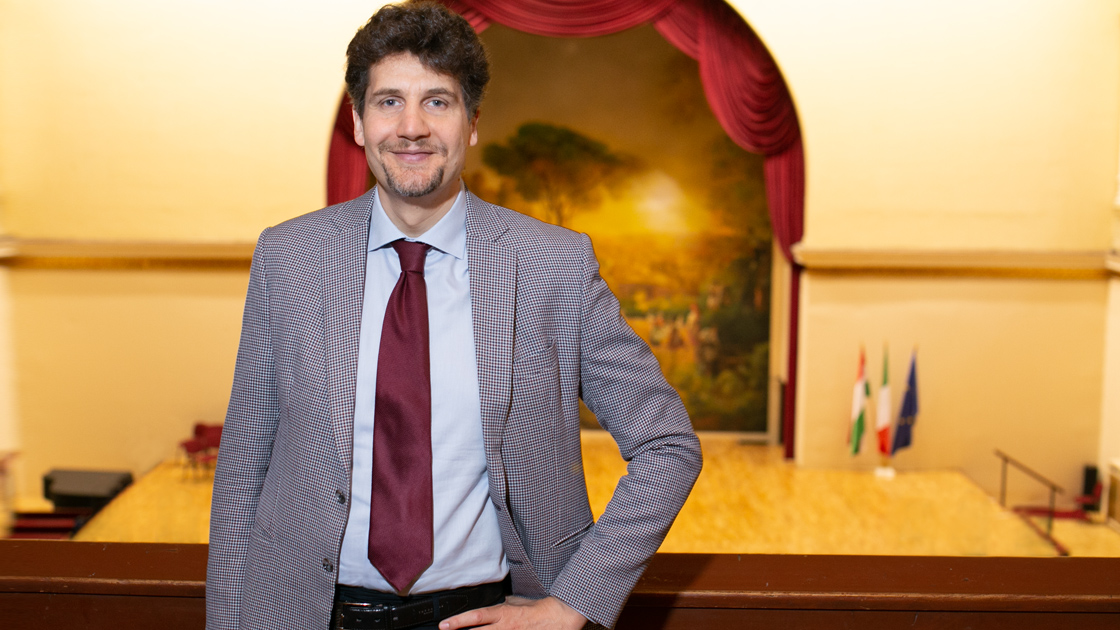

The Italian Culture Institute has been operating in Budapest uninterruptedly for 90 years now, since 1936 – and in the same building located next to the Hungarian National Museum since 1943.
“We feel at home here because there are so many references to our culture that are part of – and totally integrated into – the Hungarian culture, and that's beautiful,” the Director of the Italian Cultural Institute in Budapest, Gabriele La Posta, who is also the Cultural Attaché of the Italian Embassy, tells Diplomacy&Trade. As he explains, Italian cultural presence in this country is historically very strong. It probably began over a thousand years ago with the Italian bishop St. Gellért, the educator of Prince Imre, the son of the first Hungarian king, Stephen. The bishop, who later suffered a tragic fate, also had a role in Hungary eventually choosing the Latin alphabet over the Greek one.
Balance between tradition and innovation
As Italian classical culture is very well-known in Hungary, there has been a tendency recently for the Institute to present the less known or up-and-coming new artists, intellectuals, specialists and main protagonists of the Italian cultural scene.
“Based on the Italian classical and traditional cultural influence on Hungary, the Institute is in contact with the new productions, the new ways of living, of being in the world that Italians artistically present. So, what we do is exactly this mix between tradition and innovation. And, of course we bring here a lot of artists. They are all, by definition, contemporary artists or actors, directors, intellectuals. I have to say that Hungarians are not only already well informed of the traditions, but they also follow the recent Italian cultural developments, including Italian writers, Italian movies or Italian singers,” the Director highlights.
Actually, there are a lot of things that do not come from the Institute, “but from Hungarians organizing beautiful expositions and they call us to give a hand or to present it in a better and joint way. For example, Dolce Vita, this beautiful exhibition which is now in the Hungarian National Gallery, was conceived by our Hungarian friends. We gave our contribution to it, but it's something which represents perfectly that Hungarians have this special relationship to another culture, which is also their culture. It's part of their culture, and this is what comes from Italy: even when Italy was not a unified state, but the Italian culture was already so present. Then, we have Hungarians writing books about their experiences in Italy and they ask us to help them presenting it. There is something beautiful in that – a combination of love and knowledge. All over the world, you find people loving what Italy culturally represents, but it's not so common to find so many people like in Hungary truly knowing about it,” he notes.
Teaching Italian
The Italian Cultural Institute also plays an important role in teaching the Italian language. There are language courses held by Italian professors or by Hungarian professors very well learned in Italian language teaching. There are more than 200 schools in Hungary where Italian is taught as a second language, and there are more than 17,000 Hungarian students studying Italian. “This number has grown from 13,000 to 17,000 the last five years, which gives us the idea of how much it is appreciated by Hungarian students. We also have five universities where there is an Italian department, a department of Italian studies plus other universities where they teach Italian as a foreign language. The Italian government does not only send native Italian teachers but also offers scholarships for students to go to study to Italy. So, Hungarian institutions are well connected to Italian universities or other institutions,” Gabriele La Posta points out.
Festivals and exhibitions
As described already, the Institute organizes many different events. “Well, for us, movies in general are very, very important, and also very appreciated by the audience here. One of the main events in this respect is the MittelCinemaFest, which takes place in the first half of November every year – the 24th edition already in 2026 in two cinemas in Budapest (Puskin and Tabán) and one in Szeged (Belvárosi). Also, Itáliai utazás [‘Journey to Italy’] is a popular monthly series of contemporary Italian film screenings at the Uránia National Film Theater in Budapest. The screenings feature the latest Italian films, often accompanied by meet-and-greets and discussions with the filmmakers (directors and lead actors),” the Director says.
There are also a great number of exhibitions. Recently, the Institute hosted the one entitled ‘Gabriele Basilico. Roma’, dedicated to the great Italian master of photography and his vision of the Eternal City. It was part of the Budapest Photo Festival. “Also, last year, there was a beautiful exhibition (An Italian in Pest’) in the Castle Museum of the about Giacomo Marastoni, the men who founded the First Hungarian Painting Academy here in the 19th century. Actually, his son became a painter as well, a Hungarian painter – another argument for Italian culture being part of Hungarian identity,” he adds.
Not just in Budapest
When it comes to cultural promotion by the Italian Institute, the Director emphasizes that most of the events organized, conceived and presented are in the capital. “However, this does not mean that we do not have activities in other parts of the country – for example, in the Italian departments of universities in Szeged, Debrecen or Pécs where we are involved in academic activities and have courses to improve the quality of the Italian language teachers in those respective regions of the country. Also, every year, we have a very nice event in Balatonfüred at Lake Balaton, the Salvatore Quasimodo poetic competition named after the Nobel Prize winner Italian poet who received treatment for heart stroke and his life was saved there in the early 1960s. This year, the competition is held for the 33rd time.”
In the hearts of the people
Regarding the feedback received from Hungarians, Gabriele La Posta considers it “flattering, really – but it's not only in our professional life, also in my personal life. It happened to me several times that when talking with my family in a public place, Hungarians – fascinated by listening to Italians – actually joined in the conversation and replied in Italian, recalling their memories of the Italian language or a vacation in Italy for that matter. That's so beautiful. It's beautiful doing this job here because 90% of what we do, or should do, is already in the hearts of the people. So, you really just have to make people recognize something that is already theirs and update their knowledge, show something new on the basis of what they already know. It's really a love story, the one between Italians and Hungarians.”


Top 5 Articles
 Cherishing Italian Cultural Presence in Hungary September 3, 2026
 - Consolidating the Good Bilateral Relations May 10, 2026
- Indotek Group Acquires 100% of Auchan Magyarország June 26, 2026
- Two Vantage Points, One Direction August 22, 2026
- Ágnes Forsthoffer, Interim Hungarian President July 20, 2026