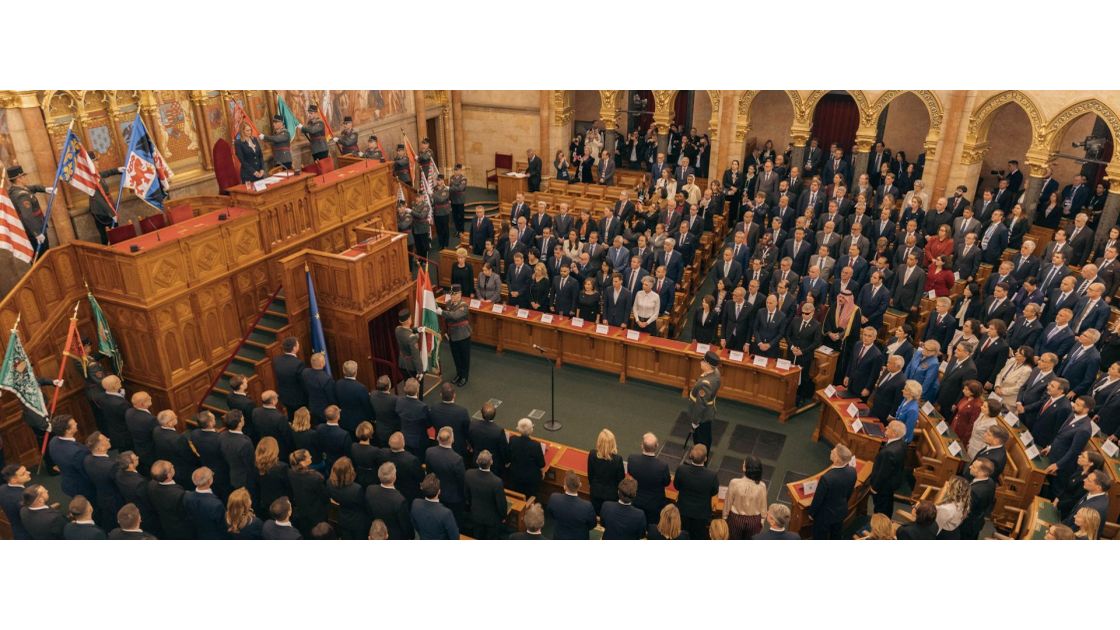

A ceremonial session was held in the National Assembly, attended by Hungarian public officials, European Union leaders, and heads of state and representatives from several countries, to mark the 70th anniversary of the revolution of October 23, 1956.
At the session, Ursula von der Leyen, President of the European Commission, greeted the attendees in Hungarian, while former NATO Secretary General Jens Stoltenberg shared his family memories of the 1956 Revolution. António Costa, President of the European Council, also delivered a speech at the ceremonial session, emphasizing: “The revolution showed the world the deeply rooted desire of the Hungarian people for self-determination and independence.”
In addition to the foreign guests of honor, the ceremony was attended by President András Baka, Prime Minister Péter Magyar, members of the government and the National Assembly, leaders of Hungary’s religious communities, members of various diplomatic corps, as well as representatives of organizations from both within and beyond Hungary’s borders.
András Baka: After the Revolution, Hungarians turned toward one another
“On this day in 1956, the heart of the nation beat for change, and the sacrifices of the revolutionaries were not in vain,” Ágnes Forsthoffer, Speaker of the National Assembly, emphasized in her opening remarks at the session. “Even seventy years later, October 23 still shows that it unites us Hungarians; this is how 1956 became a powerful symbol of national unity,” the Speaker said.
The Speaker expressed her gratitude to all the nations that provided refuge to Hungarians forced to leave their homeland after the struggle for freedom. The victims of the struggle for freedom were commemorated with a minute of silence, followed by a retrospective of the 1956 Revolution through newsreel and film clips.
“Seventy years ago, the Hungarian nation passed judgment on a system built on lies and oppression; tens of thousands took to the streets to demand justice and freedom,” President András Baka said as he began his commemorative speech. “The crowd could not yet have known that they were becoming part of one of the greatest moments in Hungarian history.”
The head of state emphasized that in the 1956 struggle for freedom, Hungarians reclaimed their right to shape their own destiny, and the whole world heard their voice. “In the photographs of the revolution, we can still see today not only the strength, tension, and determination, but also, on the faces of the demonstrators, what they had been deprived of under the dictatorship: the joy of liberation.” After the revolution, Hungarians turned toward one another, for – even if only for a few days – they had toppled a system built on division and fear, Baka said.
Ursula von der Leyen: Long Live Hungary, Long Live Europe
“On a sunny afternoon, the youth of Hungary gathered and changed the course of history,” began Ursula von der Leyen, President of the European Commission, in her speech. “With incredible courage, they stood up for their country, for freedom, and for Europe. The reprisal, however, was swift and ruthless; the Soviets crushed them with tanks. But let’s ask the question: why did the Soviets act so brutally? The answer is simple: because they were afraid. They were afraid that if the Hungarians won, the desire for democracy would spread, and they could only maintain their power through even more oppression.”
Ursula Von der Leyen emphasized that the victory of democracy is never a given, and every generation must fight for it. “This is also at the heart of this commemoration. Standing here today, however, it goes without saying what the rebirth of democracy means,” the Commission President said. “It feels good to be back in Hungary. We are one family; your history is our European history, and your future is our European future. You have once again placed your trust and faith in the European Union: this makes Europe stronger, and for that we thank you for your work. “Long live Hungary, long live Europe,” she concluded her remarks in Hungarian.
Jens Stoltenberg: Democracy is stronger than oppression
Following a performance by Zoltán Erdő, a tarogato player and recipient of the Transylvanian Hungarian Heritage Award, António Costa, President of the European Council, delivered a speech: “The uprising against the totalitarian communist regime never failed in the hearts and minds of the Hungarian people. The revolution showed the world the deeply rooted desire for self-determination and independence among Hungarians. This was the driving force behind the heroic days of 1848, it also drove the events of 1956, and it was among the first to bring down the Iron Curtain in 1989.” According to Costa, by joining the European Union, Hungary affirmed what its thousand-year history has demonstrated: Hungarians form the heart of Europe.
Speaking on behalf of Norway was Jens Stoltenberg, Norway’s Minister of Finance and former Secretary General of NATO. “Being in Budapest is always special; I’ve been here countless times, and it holds particular significance that we are commemorating 1956. I grew up listening to my mother and father’s stories about the uprising: my parents volunteered to help the Hungarians arriving at the western border, and they witnessed their courage,” Jens Stoltenberg said.


Top 5 Articles
 Cherishing Italian Cultural Presence in Hungary September 3, 2026
- Consolidating the Good Bilateral Relations May 10, 2026
- Indotek Group Acquires 100% of Auchan Magyarország June 26, 2026
- Two Vantage Points, One Direction August 22, 2026
- Ágnes Forsthoffer, Interim Hungarian President July 20, 2026