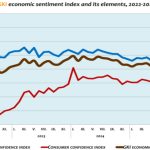
The managers of German companies operating in Hungary are more pessimistic than recent economic indicators would justify - this was the title of a survey presented by the German-Hungarian Chamber of Industry and Commerce, hvg.hu reports.
The survey revealed that business leaders put the vision of the Hungarian economy at -40 on a scale of +100 to -100. That's slightly worse than the -36 score six months ago, but better than the -51 in 2022.
Their own business expectations, on the other hand, have gone minus for the first time since the 2009 crisis, at -17.
Expectations are relatively good in the services sector, while managers in industry and commerce are pessimistic: 13% of firms in industry are optimistic about the future, compared with only 3% in commerce. But employment and investment plans have also gone into negative territory, the former for the first time since 2010 and the latter since 2009, hvg reports.
Speaking at the event, Deputy State Secretary Gábor Szőcs said "the Hungarian work-based economic model has once again proven to be crisis-proof," referring to the fact that Hungarian GDP has already grown in the third quarter compared to the second. Commenting on the survey, the Deputy State Secretary said he acknowledged that it could be a problem for companies investing in Hungary that there was little labor left to absorb, and recommended that German companies should work with Hungarian universities.
Speaking at the presentation, Radovan Jelasity, chairman of board of the Erste Bank Hungary, said that the hard times were over, inflation was slowing, the HUF exchange rate was stable despite interest rate cuts, and the banking sector had survived the rise in interest rates from 2-18% in a few years. "Confidence in the economy is slowly improving, but it is still a long way from pre-crisis levels," he said. Erste now expects GDP growth of 3.4% and inflation of 5.4% next year.


Top 5 Articles
 What Awaits the Hungarian Economy in 2026 and 2027? April 24, 2026
 - Cherishing Italian Cultural Presence in Hungary September 3, 2026
- Consolidating the Good Bilateral Relations May 10, 2026
- Two Vantage Points, One Direction August 22, 2026
- Business, Consumer Confidence at Two-Year High in April April 23, 2026