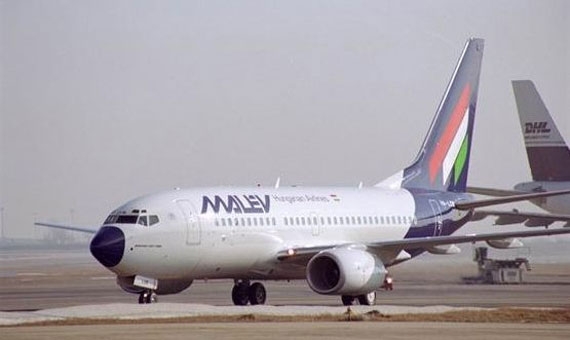

Malév Hungarian Airlines incurred a loss of HUF 24.56 billion (EUR 91.32 m) in 2010, the carrier’s balance sheet approved by a shareholder meeting on Friday showed. The loss is a bit better than the record loss of HUF 24.84 bn posted in 2009, but greater than the HUF 20 bn both Malév’s management and the Hungarian State Holding Company (MNV) projected.
There is some confusion whether the figure approved by Malév’s shareholders is a pre-tax or net loss. Malév said it was a pre-tax loss and the improvement over 2009 is HUF 275 million, but it does not add up, according to the Hungarian financial website portfolio.hu.
The Annual General Meeting (AGM) approved the resignation of CEO Martin Alexander Gauss. According to a statement issued by Malév, Lóránt Limburger, chief executive of Malév Ground Handling since 2007, was appointed acting CEO.
The AGM has not decided as to how Malév’s capital position should be settled. This call is to be made on June 24 as talks with Russia’s Vneshekonombank are still in progress.
At an extraordinary general meeting held in early April this year, majority owner MNV (the managing company of state-held assets in Hungary) granted HUF 2.5 bn worth of capital to the carrier, of which HUF 25 m was used to raise the Malév’s registered capital to HUF 440.1 m. Vneshekonombank is a minority owner in Malév via AirBridge, while the state owns 96% of the company. The Russian bank is also the main creditor of the airline. According to end-2010 data, Malév owed Vneshekonombank EUR 102 million.
Malév carried 2.984 million passengers on its scheduled flights in 2010, which corresponds to an 8% year-on-year decline. The number of flights dropped 13% compared to 2009.
2010 was a tough year for Malév for two main reasons. Firstly, the eruption of a volcano in Iceland wreaked havoc in air traffic all over Europe, forcing the closure of airspace and the cancellation of some 100,000 flights in a six-day period. This did not leave Malév unaffected, resulting in lower revenues and higher expenses. Secondly, kerosene prices started to rise last year and this is the biggest item in the airlines’ cost structure.


Top 5 Articles
 Cherishing Italian Cultural Presence in Hungary September 3, 2026
 - Consolidating the Good Bilateral Relations May 10, 2026
- Indotek Group Acquires 100% of Auchan Magyarország June 26, 2026
- Two Vantage Points, One Direction August 22, 2026
- Ágnes Forsthoffer, Interim Hungarian President July 20, 2026