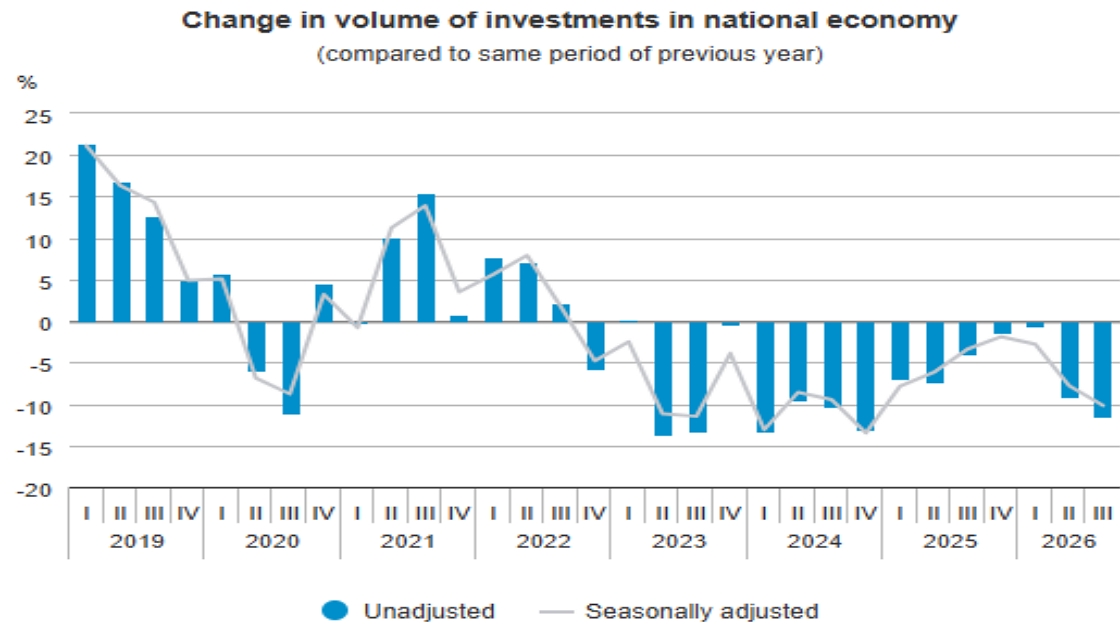

Investment volume in Hungary dropped 11.4% year-on-year in the third quarter, accelerating from a 9.1% decline in the previous quarter, data released by the Central Statistical Office (KSH) on Monday show.
Adjusted for seasonal effects, investment volume declined 10.2%.
The drop in manufacturing sector investment contributed the most to the headline decline, while higher investment in the energy industry mitigated the decrease, KSH said. Investment volume in both the private and the public sectors fell during the period, while household investments grew, it added.
In a quarter-on-quarter comparison, investment volume slipped a seasonally-adjusted 2.8%.
Commenting on the fresh data, Finance Minister András Kármán said the decline showed a "snapshot of an economy undergoing a transformation", noting steps by the Tisza government to cancel unfavorable state contracts with companies that had earlier benefited from close ties to the former Fidesz-KDNP government.
"This means lower investment volume in the short term, but it is the only way to ensure fair competition and sustainable growth in the long term," he added.
He said decisions taken by the Tisza government would appear in the investment data only later.
In a comment on the data, K&H chief analyst Dávid Németh attributed the decline to big manufacturing sector investments in the base period and a fall in state investments. He added that an influx of European Union funding could support CAPEX at SMEs in future. ING Bank senior analyst Péter Virovácz said the impact of the arrival of Hungary's unfrozen EU funding could be tangible in the fourth quarter, then show up in the data on a larger scale in the course of 2027.


Top 5 Articles
 Cherishing Italian Cultural Presence in Hungary September 3, 2026
- Indotek Group Acquires 100% of Auchan Magyarország June 26, 2026
- Two Vantage Points, One Direction August 22, 2026
- Ágnes Forsthoffer, Interim Hungarian President July 20, 2026
- Sziget Must 'Move Forward to Break Free' August 16, 2026