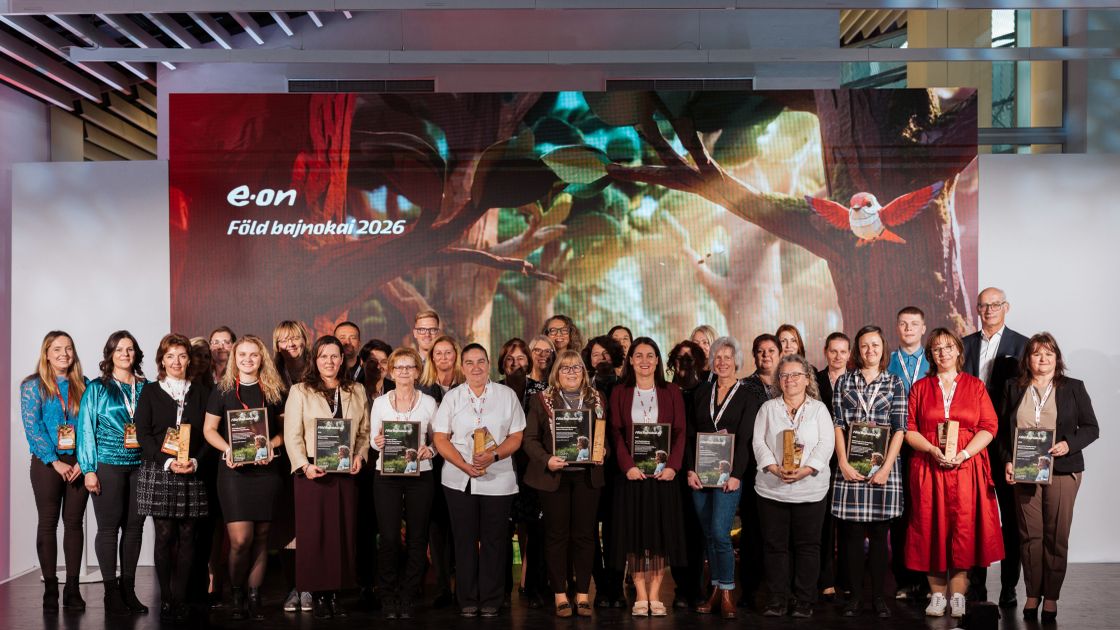

In Hungarian preschools and schools, concern about the environmental crisis has given way to a desire to take action: communities are seeking solutions and have countless ideas for saving our planet. In the “Champions of the Earth” contest – now in its fourth year – organized by the energy company that operates the power grid in Transdanubia, Pest County, and Budapest, a record number of 18 winning projects – nine from preschools, six from elementary schools, and three from high schools – received recognition and grants of up to HUF 2.5 million each.
Including these, a total of 60 kindergarten and school “planet-saving communities” – built on cooperation and active participation – have received funding over the past four years. The 42 winning projects from the previous three years have already been implemented, while this year’s winners are now beginning to bring their plans to life.
The total amount of grants awarded to date has exceeded HUF 100 million. The ideas – brought to life jointly by children and teachers, often with the involvement of parents and local communities – are local in nature, but their impact – in terms of shaping attitudes and positive environmental outcomes – extends far beyond their immediate time and place.
“Our future depends on what we do today for our environment. At E.ON, we follow this principle through our investments, our development initiatives, and our efforts to raise awareness. That is why we launched the Champions of the Earth competition – to show that every community can contribute to a more sustainable future. “Over the past four years, countless preschools and schools have demonstrated that a sense of responsibility for the environment can yield tangible results when we join forces and take action,” Guntram Würzberg, Chairman and CEO of the E.ON Hungária Group said.
In addition to the now-classic bird, insect, and habitat conservation programs, the jury was once again surprised this year by innovative ideas. It was striking how sensitively many of the winning projects responded to what is currently happening in the world around children. At the “Shade-Saving Forest” of the Kolozsvár Street Preschool in Budapest, preschoolers are preparing to create a Miyawaki mini-forest, establishing a microenvironment where shade grows alongside the children. “Trees not only provide shade, but they are also one of the most effective forms of air conditioning. They are the only natural solution for cooling communities, and even the preschoolers already know this,” according to Diána Ürge-Vorsatz, a physicist, climate researcher, vice chair of the Intergovernmental Panel on Climate Change (IPCC), and a member of the jury herself.


Top 5 Articles
 Cherishing Italian Cultural Presence in Hungary September 3, 2026
- Consolidating the Good Bilateral Relations May 10, 2026
- Indotek Group Acquires 100% of Auchan Magyarország June 26, 2026
- Two Vantage Points, One Direction August 22, 2026
- Ágnes Forsthoffer, Interim Hungarian President July 20, 2026