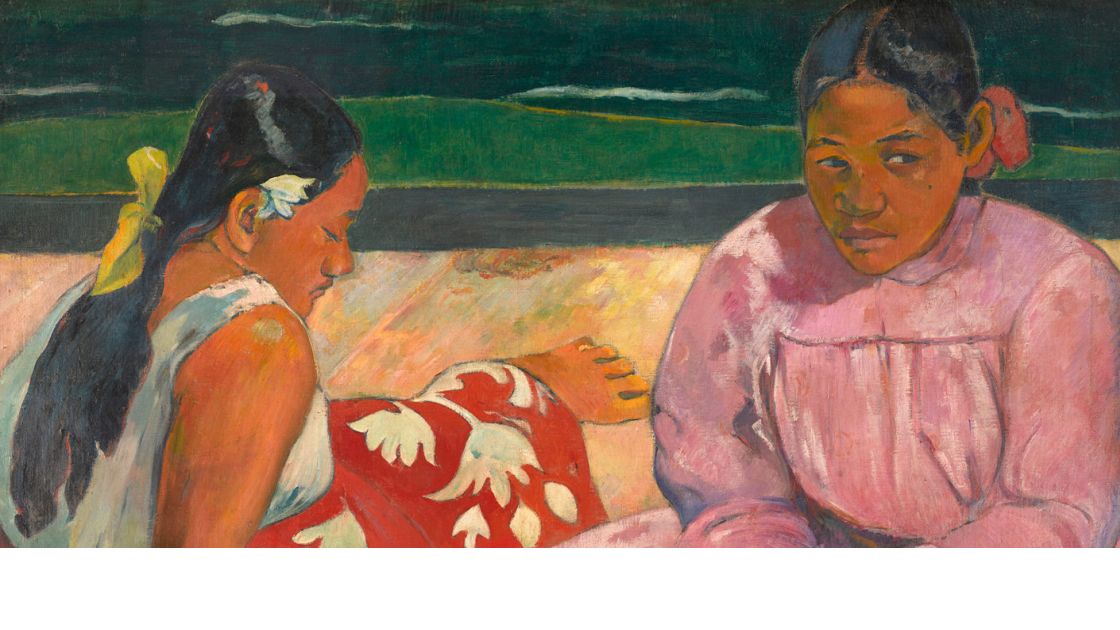

Starting this Friday, the exhibition ‘Bonjour Monsieur Gauguin – Circles of the Post-Impressionists and Symbolists’, which showcases the life’s work of French painter Paul Gauguin (1848-1903), presents a total of 150 masterpieces, including 80 works by Gauguin.
The exhibition is part of the “French series” launched more than twenty years ago, as part of which the public was able to view works by Monet in 2003, Van Gogh in 2006, and Cézanne in 2012 and 2021 at the Museum of Fine Arts, the museum’s director general, László Baán, said at a press event in Budapest to introduce the exhibition.
The Paul Gauguin exhibition is Hungary’s first large-scale exhibition on the master and represents an outstanding international undertaking; we are indebted, first and foremost, to the nearly forty public and private collections around the world that have loaned their masterpieces to make this exhibition possible.
The exhibition presents Gauguin’s art not only chronologically, following the evolution of his style, but also through his intellectual and conceptual development. It retraces the search for creativity that led the art of late nineteenth-century France towards the foundations of modernity, the museum says.
Particular emphasis is placed on Gauguin’s network of relationships: an analysis of his friendships and creative ties with artists (Camille Pissarro, Claude Monet, Paul Cezanne, Vincent van Gogh, Émile Bernard, Paul Sérusier, Jens Ferdinand Willumsen, József Rippl-Rónai), literary figures (Stéphane Mallarmé, August Strindberg) and art critics.


Top 5 Articles
 Cherishing Italian Cultural Presence in Hungary September 3, 2026
- Consolidating the Good Bilateral Relations May 10, 2026
- Indotek Group Acquires 100% of Auchan Magyarország June 26, 2026
- Two Vantage Points, One Direction August 22, 2026
- Ágnes Forsthoffer, Interim Hungarian President July 20, 2026