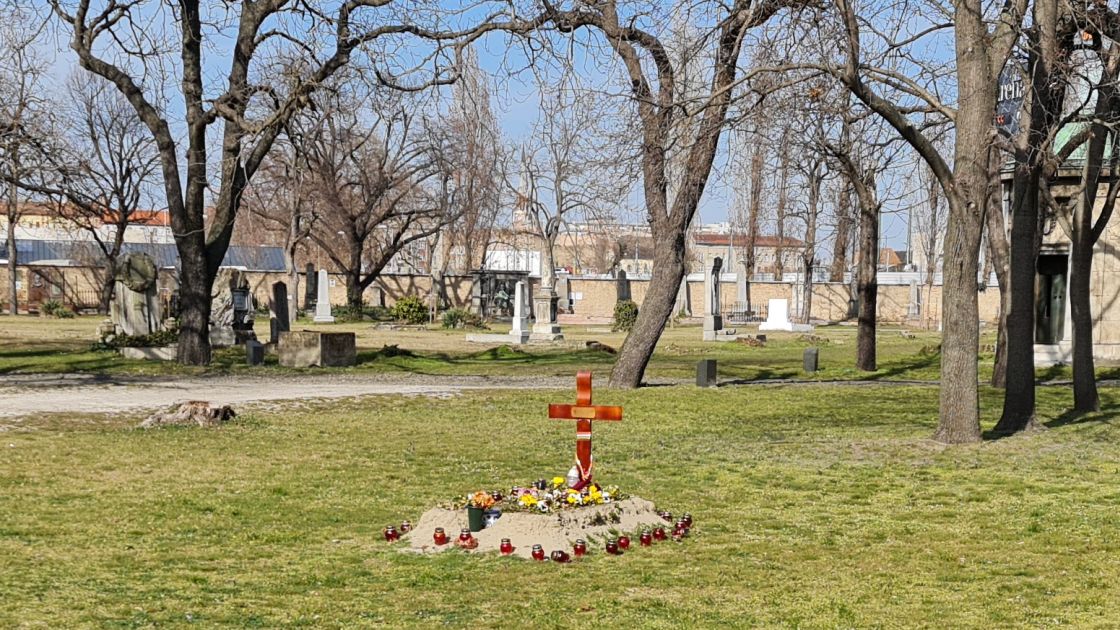

A commemoration to mark the European Day of Remembrance for Victims of All Totalitarian and Authoritarian Regimes was held at the grave of Margit Slachta, a nun who worked to save Jews from persecution, in the Fiumei Road Cemetery in Budapest on Sunday.
Zsolt Sári, the state secretary for public collections and heritage preservation, highlighted Slachta's fight against tyranny and injustice and noted that she was Hungary's first woman member of parliament.
He said the government has a "zero tolerance" policy for any violence or verbal aggression against communities, minorities or groups of people. "Dictatorships start with words, not barbed wire," he added.
Zsolt Sári emphasized that we must remember the tragedies of our past, but that this remembrance does not mean mere reflection; rather, it is an active testimony to those who sacrificed their lives for the freedom that forms the foundation of our society today.
The totalitarian regimes of the 20th century shaped the history of all of Europe and destroyed the lives of millions of people; yet by establishing the European Day of Remembrance for the Victims of Totalitarian Dictatorships, Europe has also recognized the importance of shared memory as the foundation of our common identity and solidarity, the state secretary pointed out.
The EEuropean Day of Remembrance for Victims of All Totalitarian and Authoritarian Regimes is observed on August 23, commemorating the fact that on this day in 1939, the Stalinist Soviet Union and Hitler’s Germany signed a non-aggression pact; The pact was signed by Soviet People’s Commissar for Foreign Affairs Vyacheslav Molotov and German Foreign Minister Joachim von Ribbentrop.


Top 5 Articles
 Cherishing Italian Cultural Presence in Hungary September 3, 2026
 - Consolidating the Good Bilateral Relations May 10, 2026
- Indotek Group Acquires 100% of Auchan Magyarország June 26, 2026
- Two Vantage Points, One Direction August 22, 2026
- Ágnes Forsthoffer, Interim Hungarian President July 20, 2026