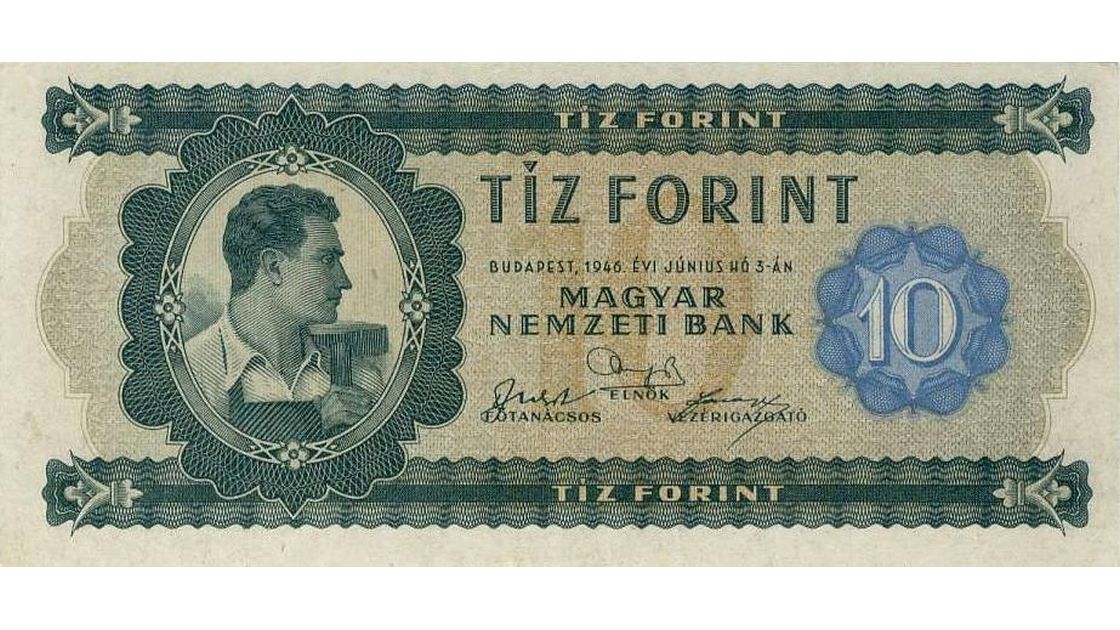

The forint was introduced in Hungary on August 1, 1946. The issuance of the new currency was necessitated by the pengő’s incredible rate of inflation following World War II — a level of inflation unprecedented in world history.
The forint entered circulation in Hungary on August 1, 1946. By that year, the pengő due to inflation,
In the months leading up to the introduction of the forint the pengő — the currency that preceded it — had depreciated severely. It lost value so rapidly that banknotes with increasingly higher face values appeared every few weeks, and Hungary printed the highest-denomination paper currency in history: the 100-million B-Pengő note.
At the height of the crisis, prices doubled every 11 to 15 hours, meaning that the value of money halved several times a day. According to accounts, inflation reached such extreme levels that it was not uncommon for people to carry their pay to stores in wheelbarrows or sacks just to be able to buy anything at all.
The only remedy for this untenable situation was the introduction of the new currency, the forint. Upon its introduction, one forint was equal to 400,000,000,000,000,000,000,000,000,000 pengős.
The new currency was backed by Hungary’s gold reserves, which had just been returned from American custody by the US Army. The Hungarian National Bank’s repatriated gold reserves — amounting to 29 metric tons, consisting of 2,696 gold bars and 40 sacks of gold coins — arrived back in Budapest on August 6, 1946.
The name 'forint' dates back to Florence: modeled after the local gold coin, the fiorino, King Charles Robert of Hungary had gold forints minted as early as the 14th century.


Top 5 Articles
 What Awaits the Hungarian Economy in 2026 and 2027? April 24, 2026
 - Cherishing Italian Cultural Presence in Hungary September 3, 2026
- Consolidating the Good Bilateral Relations May 10, 2026
- Two Vantage Points, One Direction August 22, 2026
- Business, Consumer Confidence at Two-Year High in April April 23, 2026