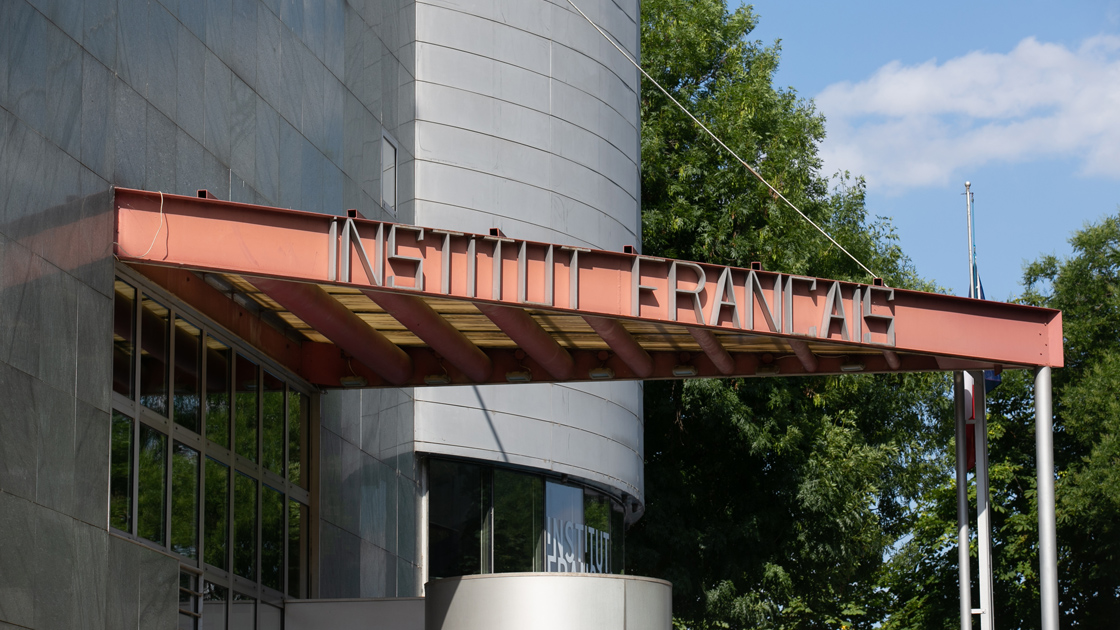

Established in 1947, the French Institute in Hungary is one of the oldest foreign cultural centers in Budapest. It has lived through many events in Hungarian history over these years, has organized numerous programs and collaborations, having moved within the city several times.
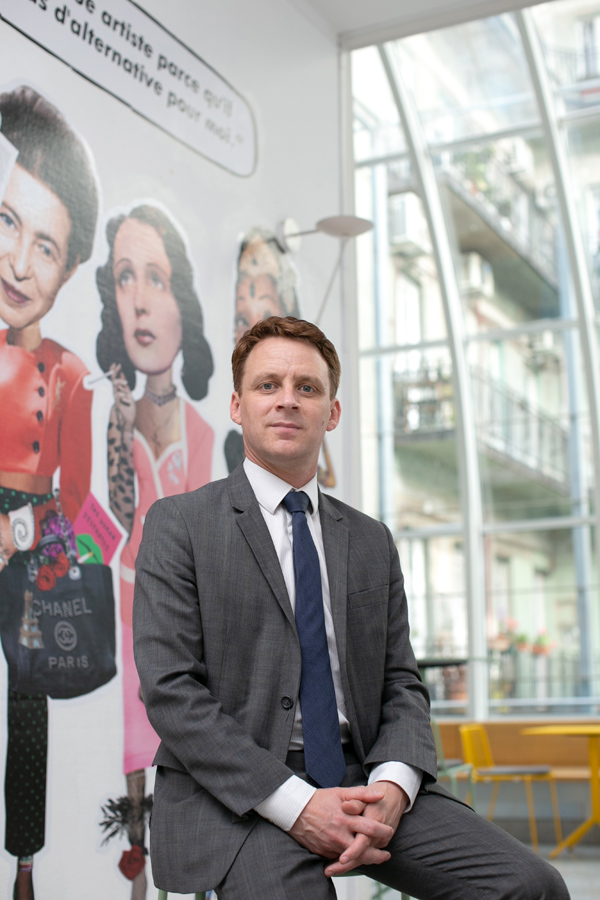
The Director of the French Institute, Matthieu Berton, who is also Cultural and Cooperation Advisor at the French Embassy in Hungary, recalls that the creation of this institute in 1947 was important because it was the first cultural center to open in Central and Eastern Europe for France after World War II. The center was first located on the Pest side of the capital but an idea of building a new institute appeared in 1981-82 after the election of Francois Mitterrand, the socialist president of France. With his support, negotiations were conducted with the Hungarian government and an architecture competition took place in 1984 with the renowned French architect Georges Maurios winning the project. The modern, 4,000-sqm building that has housed the French Institute ever since was inaugurated in 1992 in a prime spot on the Buda side of the Danube.
As the Director tells Diplomacy&Trade, “this is very important for us because I believe this is now an iconic building of Budapest. Its architecture and location give the institute very strong visibility and an important role in Hungarian cultural and intellectual life.” He also mentions another significant date in the history of the institute: 1956 “when the then director, Guy Turbet-Delof, helped to save Hungarian artists and artworks during the revolution. There has been academic work on his activities, on his life that will be the theme of an exhibition we will organize next year.”
Versatile activities
The French Institute in Budapest is to promote French language and culture and to encourage cross-cultural exchange by also presenting European values.
“This exceptional building of 4,000 square meters has great facilities such as a 200-seat auditorium where we can organize a lot of shows, performing art and a conference lecture workshop as well as movies twice a week and during festivals. We also have a three-floor major library with more than 30,000 books. We buy new books every year, so it's not only books from the 1990s. And, of course, we also have a language center with nine classrooms,” he highlights.
“The Institute has a very strong network of Hungarian partners who support our work every day or organize their own French related events – not only in Budapest. As for finance, we receive funding from the French Ministry for Europe and Foreign Affairs in Paris with around 50% of our budget coming from that source. And we also generate our own income, especially with French language courses for more than 1,500 students – children and adults alike – every year. We have a team of around 40 people working here at the French Institute in Budapest, the majority of them are Hungarian,” Matthieu Berton says.
Supporting French language education
The Institute works very closely with French-speaking embassies in Hungary, especially with those of Switzerland, Canada and Belgium, but also with Moroccan, Lebanese and some other French-speaking embassies here. The Director stresses that “together, we form the group ‘Les Amis de la Francophonie’ (The Friends of Francophonie). We organize a lot of meetings and coordinate our action to support French language education in Hungary while respecting the role of the Hungarian authorities. We are not in charge of linguist policy, but we support education and we focus on maintaining and developing high school programs. There are ten bilingual sections, which are key for promoting French language education in Hungary. We also support French as a second language, especially in the big cities. During the Month of Francophonie, for four or five weeks in March every year, we organize together scientific and cultural education events and programs here at the French Institute as well as in Hungarian cultural institutions, also supporting a lot of events in Hungarian high schools where French is taught.”
Not just in the capital
Of course, many of the events organized by the French Institute take place in Budapest “because Budapest is Budapest. It's a city of close to two million people and a lot of major institutions. However, we also work in other parts of the country because Hungary is not only Budapest, and I am the director of the French Institute in Hungary and not in Budapest.
We focus on major cities where we have Alliance Française, which is a small association to promote French culture and Francophonie (in Pécs, Debrecen, Szeged, Győr and Miskolc) as well as Veszprém with which we built a very strong connection when it was one of the European capitals for culture in 2023. We work with cultural institutions like Agóra in Veszprém or with the Vasarely Museum or the Zsolnay Center, both in Pécs. We cooperate with high schools that have bilingual programs in eight cities in Hungary and with the French department in three provincial universities (Pécs, Szeged and Debrecen), where French is taught. You can become a translator or a teacher if you go to one of these universities,” he points out.
Bilingual programs for everybody
The institute also serves as a hub and second home for thousands of French people living in Hungary. Matthieu Berton underlines that “officially, there are about 2,500 French citizens living in Hungary but the real number is probably closer to 4,000. Some of them are not registered and a lot of them are students who are here only for six months or a year. Many of them come regularly to the French Institute where all of our programs are bilingual, that is, easy to follow, even if you don't speak Hungarian, because some of the French don't speak Hungarian. People also enjoy borrowing books from the library, relaxing at the café we have here at the French Institute. The top event of the year, of course, is the Bastille Day Street Ball that has been organized annually since the opening of the Institute. There are around a thousand people coming for this free street ball, a very big and festive event for the whole French community in Hungary.”
Events throughout the year
Looking at the busy schedule full of various programs in 2025, the Director highlights the Francophone film Days, which took part in March, and “was a great success again this year with thousands of viewers all across the country watching around 30 new movies from 2024 or 2025 in one of the biggest movie festivals in Hungary, an event we are very proud to have been organizing for many years. Right now, we are also equally proud to present a major French contemporary art exhibition at the Ludwig Museum here in Budapest. It is the largest exhibition of its kind ever shown worldwide with the works of 17 award-winning French or France-based artists presented.”
As for cultural and scientific events in the rest of the year, he stresses that “possibly in October, we will organize an environmental month and it will be an important moment because it will be the 10th anniversary of the Paris Agreement. We have already organized a lot of cultural and scientific events dedicated to environment, applied to AI or some other topics. Also, we launch a new concert series here at the French Institute from September.”


Top 5 Articles
 What Awaits the Hungarian Economy in 2026 and 2027? April 24, 2026
 - Cherishing Italian Cultural Presence in Hungary September 3, 2026
- Consolidating the Good Bilateral Relations May 10, 2026
- Indotek Group Acquires 100% of Auchan Magyarország June 26, 2026
- Two Vantage Points, One Direction August 22, 2026