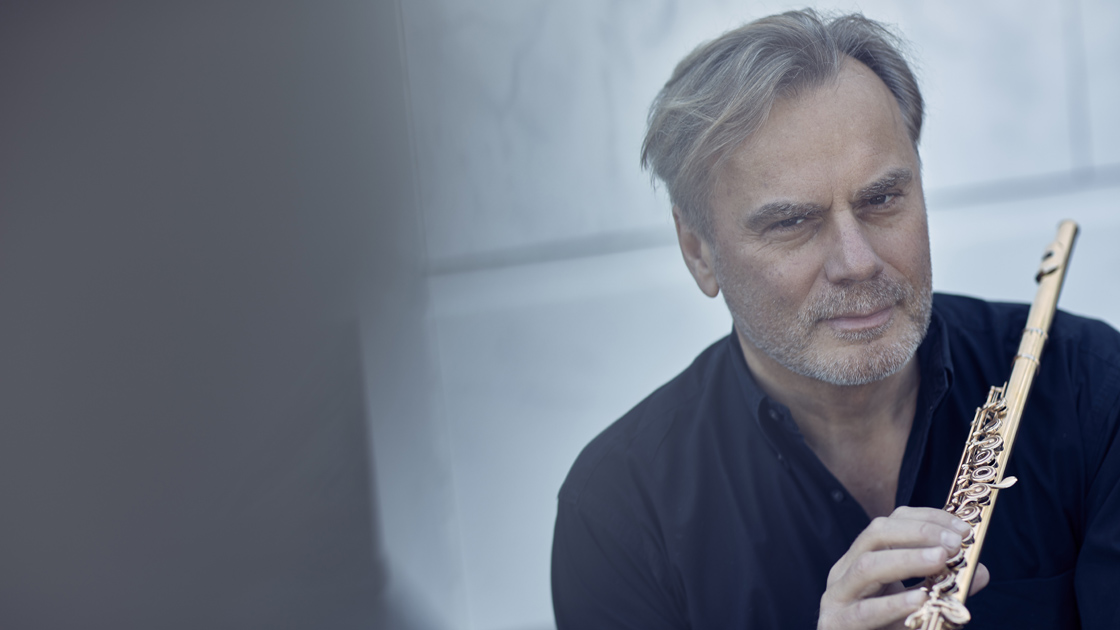

The flute is often described as one of the instruments closest to the human voice: pure, lyrical and capable of expressing a remarkable range of emotion. Its sound can sing with extraordinary clarity, but it can also whisper, breathe and convey feelings with striking intimacy.
For internationally acclaimed flautist Andrea Griminelli, this expressive power became clear at a very early age. He was only ten years old when he first discovered the instrument, yet the encounter proved decisive. From the very first note, he recalls being fascinated by its voice and by the endless palette of colors it could create.
As a child, what captivated him most was the elegance of the flute. Looking back today, he sees that early choice as something far more significant than the beginning of musical training. It was, rather, the discovery of a personal language: “choosing the flute was not simply choosing an instrument – it was choosing the language through which I would express myself for the rest of my life.”
The gift of working with Pavarotti
Among the defining chapters of Andrea Griminelli’s career, his long collaboration with Luciano Pavarotti occupies a special place. Their artistic relationship lasted for more than forty years and included well over two hundred concerts around the world. For him, each performance with the legendary tenor remains an unforgettable experience.
He describes Pavarotti not only as the greatest tenor of his time, but also as an extraordinary human being – generous, passionate and deeply committed to bringing classical music to everyone: “Luciano was much more than the greatest tenor of our time; he was an extraordinary human being.”
Over the decades, Andrea Griminelli has also shared the stage with a wide range of exceptional artists, including Andrea Bocelli, Sting, Zucchero, Sir James Galway and Ian Anderson. He has worked with conductors such as Gustavo Dudamel, Seiji Ozawa, Sir Roger Norrington, Myung-Whun Chung, Yutaka Sado and Yutaka Otomo, and has performed with many of the world’s leading orchestras.
Each of these collaborations, he says, has left a mark on him. They have taught him something new and enriched him both musically and personally.
Concert halls with their own soul
Andrea Griminelli’s career has taken him to some of the world’s most prestigious concert venues, among them La Scala in Milan, Carnegie Hall in New York, Suntory Hall in Tokyo, the Musikverein in Vienna and the Berliner Philharmonie. Each of these halls, he believes, has its own personality and its own history.
Performing in such places is always an emotional privilege, because one feels connected to generations of legendary musicians who stood on those stages before. Yet for him, the reputation of the venue alone is not what creates the true magic of a concert: “what truly makes these places extraordinary is the audience.”
Whether he performs in New York, Tokyo, Milan, Budapest or a small town, the essence of a concert remains the same – the emotional connection between the artist and the people listening. That connection, he believes, is what makes every performance unique: “the real magic happens when there is an emotional connection between the artist and the people listening.”
Music without boundaries
Throughout his career, Andrea Griminelli has built a remarkably wide repertoire, guided by the belief that music has no boundaries. His musical world extends from Baroque masterpieces by Bach and Vivaldi to Mozart’s timeless concertos, from the French Impressionism of Debussy and Fauré to contemporary works written especially for him.
He has performed works by composers such as Ennio Morricone, Carlo Boccadoro and Akira Ifukube, and he values contemporary repertoire because it allows him to explore new sounds and contribute to the expansion of the flute literature for future generations.
Still, if he had to name a composer especially close to his heart, he says he would choose Mozart. “Mozart remains very close to my heart because his music combines simplicity and perfection in a way that is almost impossible to describe.”
For him, this balance between clarity and depth, between apparent simplicity and absolute mastery, is what makes Mozart’s music timeless.
The audience at the center
The audience has always played a central role in Andrea Griminelli’s artistic philosophy. While technical perfection is important, he believes that emotion is what people truly remember after a concert. The greatest compliment he can receive is not simply praise for virtuosity, but the knowledge that his music has touched someone. As he puts it, “the greatest compliment I can receive is when someone tells me that my music moved them or helped them experience something beautiful.”
This connection now extends far beyond the concert hall. Through his YouTube channel, he reaches listeners from every corner of the world. Messages arrive from young flute students, professional musicians and people who simply love music. For him, these reactions confirm – and he finds it wonderful to know – that the power of music continues to connect and unite people beyond language, culture and geography.
Hungary’s musical sensitivity
Hungary holds a special place in Andrea Griminelli’s artistic life. He has performed many times in Budapest and has also appeared as a guest artist and jury member on Virtuosos, the Hungarian-founded classical music talent show.
He speaks of Hungary as a country with one of the richest musical traditions in Europe – the homeland of Ferenc Liszt, Béla Bartók and Zoltán Kodály, whose legacy continues to inspire musicians throughout the world. “Hungary has one of the richest musical traditions in Europe,” he points out.
What has impressed him most, however, is not only the strength of this heritage, but the quality of Hungarian musical life today. He describes Hungarian audiences as knowledgeable, passionate and sensitive, and he has felt a special connection with them during his appearances in Budapest.
The young musicians he encountered through Virtuosos also left a strong impression on him. In his view, their exceptional level reflects Hungary’s continued commitment to music education. What impressed him the most is “the exceptional level of the young musicians.”
For this reason, returning to Hungary is always something he looks forward to. Each visit, he says, is not only an artistic occasion, but also a personal pleasure.


Top 5 Articles
 What Awaits the Hungarian Economy in 2026 and 2027? April 24, 2026
 - Cherishing Italian Cultural Presence in Hungary September 3, 2026
- Consolidating the Good Bilateral Relations May 10, 2026
- Two Vantage Points, One Direction August 22, 2026
- Business, Consumer Confidence at Two-Year High in April April 23, 2026