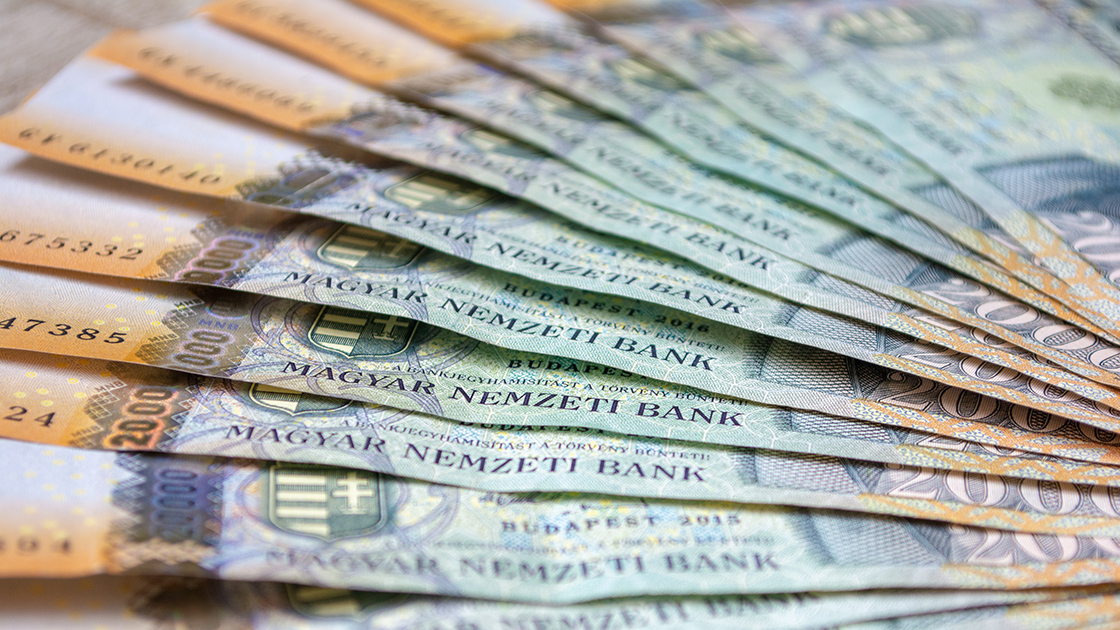

Hungary’s forint weakened to levels last seen in April as international currency market movements coupled with a record number in COVID-19 infections in Hungary put the forint under pressure. Could a weaker forint be here to stay in the longer run?
The Hungarian forint fell to its weakest level since late April on Wednesday, moving in tandem with other central European currencies in the wake of a strengthening U.S. dollar. The dollar has hit a losing streak recently, sending the euro to its strongest level against the American currency since mid-2018. European emerging market currencies benefited from the weak dollar over this period; however, the reversal in the weakening of the USD was bad news for the CEE.
Closer look at the forint
One could argue that international money market developments often trigger region-wide currency drops and this may easily be the case this time around as well. However, a closer look at the forint reveals that the Hungarian currency has posted the weakest performance among its CEE peers after the National Bank of Hungary loosened monetary policy amid the coronavirus crisis and after Hungary's second-quarter economic output contracted the most in central Europe, further fueling market concerns. In addition, the number of coronavirus infections in Hungary hit an all-time high this week, adding to worries that the second wave of the epidemic may further undermine the country’s economy. The relative exchange rate performance of the past month shows that the forint dropped by 4% against the euro, while the Polish zloty and the Czech koruna only fell by around 1%, meaning that the Hungarian currency has become an underperformer.
Technically speaking
The Hungarian currency failed to recoup its losses by Thursday and was still trading close to a five-month low against the euro. Currency market technical indicators suggest that the forint could be testing technical resistance at around 358.4 and may be headed for further weakening. The forint fell to its current historic low of 369.8 against the euro in early April and it was only able to strengthen back to 342.6 in June. Then the currency started to weaken again, and by the beginning of August, it moved into a range close the 344 level. It is no coincidence that the forint was unable to strengthen during the summer months despite the favorable global investor climate and the rebound from the corona virus crisis. The currency faced a very strong technical resistance at 340.7 versus the euro and failed to breach it. Now the 360 level could be the new psychological resistance for the forint and if breached, a heftier currency weakening could be in the cards.
Monetary policy background
Hungary’s central bank under the leadership of Governor György Matolcsy has been pursuing a dovish monetary policy, trying to keep borrowing costs as low as possible. In June, policy makers unexpectedly cut the base rate to 0.75%, in a response to the greater-than-expected decline in economic output in the wake of the coronavirus pandemic. The forint immediately weakened after the surprise rate cut, falling to one-month-lows past 350 per euro.
Analysts at Fitch Solutions warned in the aftermath of the rate cut that the central bank’s dovish monetary policy stance would weigh on the currency over the short term.
Nevertheless, the central bank stressed in June that the lowering of borrowing costs was a one-off move and not the start of an easing cycle. True to their word, policy makers left the benchmark interest rate unchanged at their meetings in July and August. The bank’s latest press release noted that the Monetary Council does not see room for lower money market rates even though the Council still expects the pressure on core inflation to ease going forward.
“We expect the MNB to be less tolerant than before of any more permanent depreciation of the forint,” Gergely Tardos, chief economic analyst at OTP Bank in Budapest said in a research note. He added that instead of direct market intervention (a very rare occurrence in Hungary), the central bank will try to manage the exchange rate through FX swaps.
Should this be the case, the Hungarian currency may find a shelter of sorts during times of international market turbulence or in the event of a deepening of the coronavirus crisis.


Top 5 Articles
 What Awaits the Hungarian Economy in 2026 and 2027? April 24, 2026
 - Cherishing Italian Cultural Presence in Hungary September 3, 2026
- Consolidating the Good Bilateral Relations May 10, 2026
- Indotek Group Acquires 100% of Auchan Magyarország June 26, 2026
- Two Vantage Points, One Direction August 22, 2026