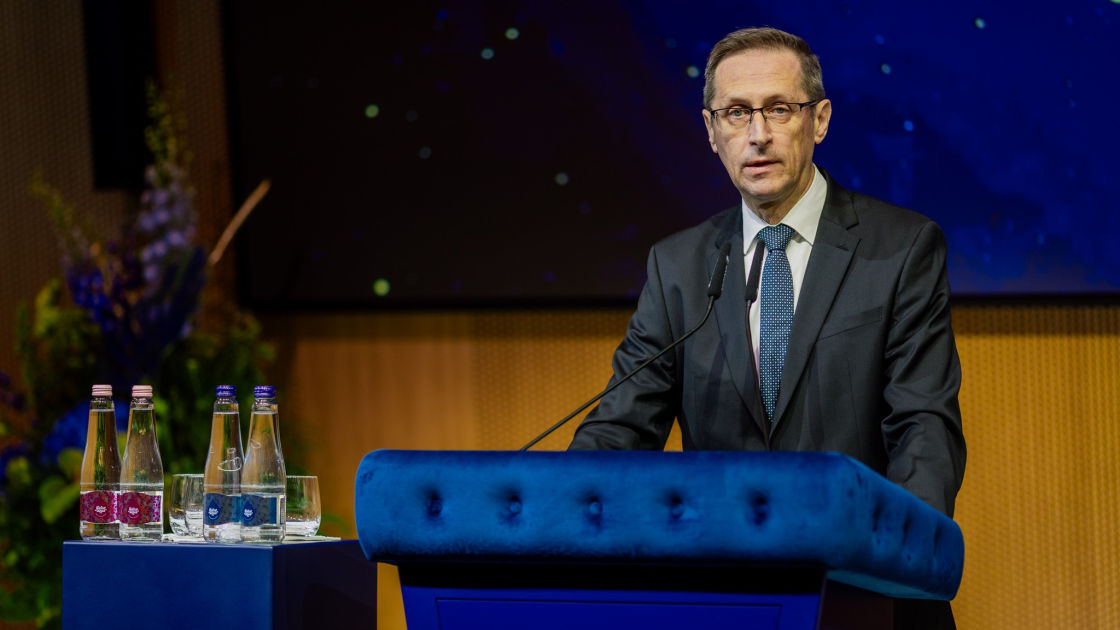

Meeting the criteria necessary for joining the eurozone is in Hungary's interest, but adopting the common currency should not be seen as "an end in itself," Mihály Varga, the governor of the National Bank of Hungary (MNB), said at a conference in Budapest.
Opening the 11th Lámfalussy Conference, Mihály Varga said the time for Hungary to join the eurozone would come when the country's economy could maximize the benefits of adopting the common currency, while minimizing the risk stemming from a fixed exchange rate mechanism and a unified monetary policy.
Achieving and maintaining price stability remains the primary goal of the MNB, while strengthening financial stability and economic resilience are also important tasks, he said.
He noted that CPI had been brought down to the central bank's 3pc +/-1pp tolerance bank, while the forint had firmed from around 410 to under 360 against the euro.
Adam Glapinski, the head of Poland's central bank and the recipient of this year's Lámfalussy Sándor Prize, pinned the decline in Europe's economic weight and competitiveness on overregulation and high energy prices.
Martin Kocher, the governor of Austria's central bank, said the euro had become one of the most important currencies in the world over the past 25 years and was now an important stabilising factor in the European economy.
The lecture series is named after the Hungarian-born Alexandre (or 'Sándor') Lámfalussy, the "father of the euro."


Top 5 Articles
 What Awaits the Hungarian Economy in 2026 and 2027? April 24, 2026
 - Cherishing Italian Cultural Presence in Hungary September 3, 2026
- Consolidating the Good Bilateral Relations May 10, 2026
- Two Vantage Points, One Direction August 22, 2026
- Business, Consumer Confidence at Two-Year High in April April 23, 2026