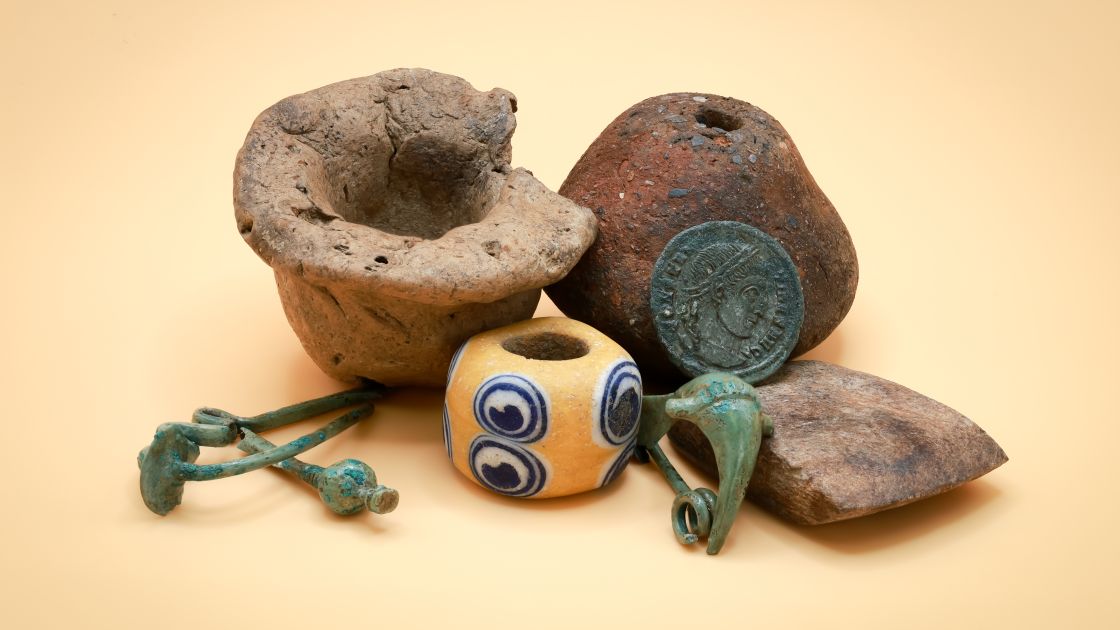

A silver treasure dating back more than two thousand years, a brick fragment bearing the paw print of a Roman-era dog, unique pieces of jewelry, and prehistoric tools were recently unearthed during archaeological excavations conducted in connection with the construction of E.ON’s new substation in Szombathely. The artifacts, spanning nearly 7,000 years, offer a glimpse into Szombathely’s past – an area that was home to settlements, workshops and farms even millennia ago.
The group’s new Szombathely substation was built on an archaeological site, which is why archaeological surveys were necessary even during the project’s preparatory phase.
Experts from the National Institute of Archaeology at the Hungarian National Museum’s Public Collections Center worked on the site between 2023 and 2025. During the archaeological work carried out before construction began and in parallel with the earthworks, nearly four hundred archaeological sites and several thousand artifacts were uncovered, dating from the 5th millennium BCE all the way to the early modern period.
The biggest sensation was a Celtic silver coin hoard consisting of more than 200 pieces and weighing over two kilograms, which was hidden just 30-40 centimeters deep in the ground. The so-called Velem-type tetradrachms, dating from the late 2nd century BCE to the early 1st century BCE, were hidden by the Celts in a pit, while some of the coins were placed in a small vessel. Agricultural cultivation over the centuries had disturbed the hoard, which lay hidden at a shallow depth. Archaeologists first discovered a few coins, then, with the help of metal detector experts, gradually made their way to the central part of the hoard.
During the excavation, numerous artifacts were also unearthed that shed light on the daily lives of those who once lived here. One of the oldest is a small, polished stone chisel-axe dating back nearly 7,000 years, which was presumably used for clearing forests, woodworking, and construction. A glass bead with a peacock-eye pattern from the Early Iron Age – dating to the 7th-6th centuries BCE – was also discovered; it may once have adorned a piece of jewelry. Archaeologists also found vessels from the same period that were used to place food and drink alongside the deceased to accompany them into the afterlife. From the Celtic period, two intact stones from a hand mill found in a building sunk into the ground preserve the memory of daily life in those days.
During the Roman period, a villa estate operated on the site; its buildings were completely demolished over the centuries, and their building materials were carried away. During the current excavation, however, archaeologists have managed to partially reconstruct the floor plan of the central building. The excavated section of the building covered approximately 300 square meters. It was here that the unique brick fragment bearing the imprint of a dog’s paw was discovered. According to the archaeologists, the brick may once have been used to cover the furnace chamber of the Roman underfloor heating system.
The excavations have brought to light previously little-known details of Szombathely’s past. Today, E.ON’s new electrical substation operates at the site of the archaeological excavations. As part of the Danube InGrid project, the corporate group built the Szombathely North substation at a cost of HUF 7.5 billion and carried out the related grid upgrades. The project helps meet the growing electricity demand of the city and the surrounding industrial areas.
Through close cooperation between E.ON and archaeologists, the excavations were successfully coordinated with the project’s preparation and implementation. Thus, alongside the construction work, the professional excavation, documentation, and preservation of archaeological artifacts were ensured.
The public will soon be able to view the artifacts at a temporary exhibition at the Savaria Museum in Szombathely.


Top 5 Articles
 Cherishing Italian Cultural Presence in Hungary September 3, 2026
- Indotek Group Acquires 100% of Auchan Magyarország June 26, 2026
- Ágnes Forsthoffer, Interim Hungarian President July 20, 2026
- Two Vantage Points, One Direction August 22, 2026
- Sziget Must 'Move Forward to Break Free' August 16, 2026