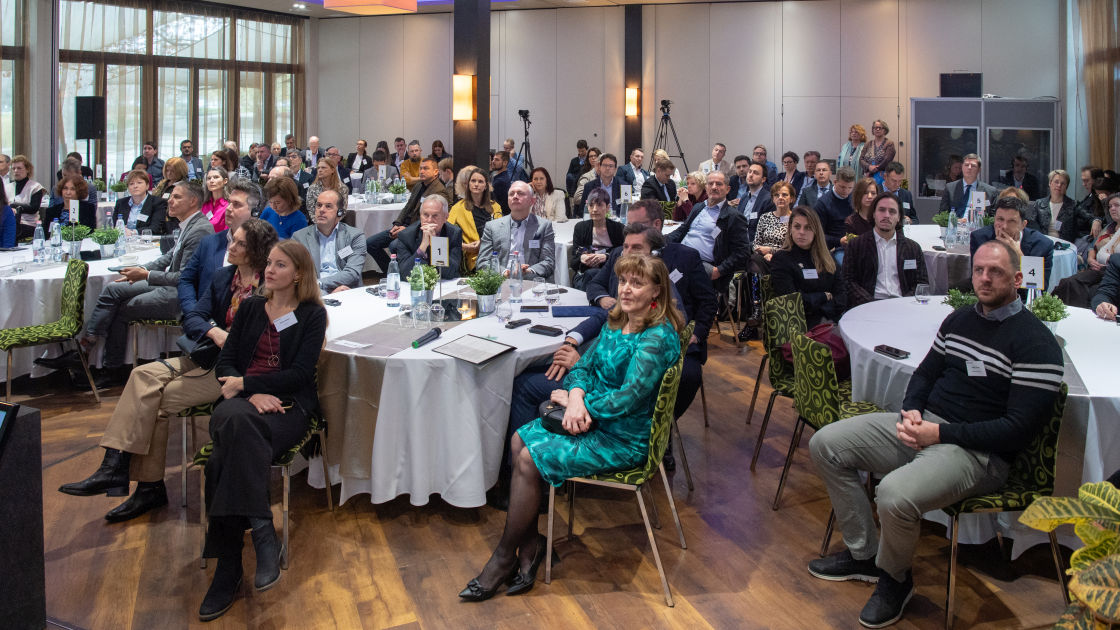

The Circular Economy Summit in Hungary has been held for the eighth time at the Öbölház event venue in Budapest, where corporate leaders, researchers, and policymakers gathered to discuss the latest challenges and opportunities associated with the circular transition. The event was hosted by Willem van Ee, Ambassador of the Kingdom of the Netherlands, and Attila Chikán Jr., President of the Business Council for Sustainable Development in Hungary (BCSDH).
“The Circularity Gap Report 2025 shows that although we have taken small steps forward, due to increasing material use, only 6.9% of material flows can be considered circular, which represents a setback compared to last year’s 7.2%. Growing material consumption is responsible for 60% of harmful climate impacts, more than 90% of biodiversity loss and water stress related to land use, and around 40% of health-damaging particulate pollution. This is a clear signal that systemic change, cooperation, and consistent corporate action are needed to advance the transition to a circular economy,” Attila Chikán Jr. highlighted in his opening remarks.
“The main findings of the report highlight that global material use continues to grow while circular performance is declining. The foundations of the linear model – large-scale extraction, short product lifecycles, and high levels of waste generation – are hindering the sustainable functioning of the economy. Although efficiency and technological developments are improving, these alone cannot counterbalance the rising demand for materials. The report emphasizes that recycling on its own could raise the circularity rate to a maximum of only 25%, which is why prevention, new business models, material substitution, longer product lifecycles, and systemic cooperation are indispensable,” he added.
The keynote speaker at the event was Prof. Dr. Jacqueline Cramer, emeritus professor at Utrecht University, who presented how significant progress toward a circular economy can be achieved at both national and sectoral levels, using the Dutch Concrete Agreement as an example. In her lecture, she pointed out: “The transition to a circular economy offers an exciting opportunity to reduce environmental burdens while strengthening business development and innovation. At the same time, no single company, government, or citizen can accomplish this transition alone. To realise change, cooperation among product chain partners or regional actors is needed. Independent intermediaries, so-called brokers, can help coordinate stakeholders and accelerate the process.”
“BCSDH’s international event, which involves bringing the European Circular Economy Hotspot meeting to Budapest on 5–7 October 2026, aims to highlight the importance and opportunities of the circular economy. Our goal is to showcase the most innovative circular and sustainable economic practices, promote Hungary’s achievements and support the creation of new collaborations,” Irén Márta, Managing Director of BCSDH, pointed out.
Ambassador Willem van Ee highlightedthat "we say in the Netherlands: “We cannot direct the wind, but we can adjust the sails.” Through forward-looking policies, innovative partnerships, and collective commitment, we are indeed adjusting our sails — steering our economy toward a circular, sustainable and regenerative future that other nations can learn from."
Hungarian policy directions were presented by Dr. Péter Bera, Head of Department at the State Secretariat for Circular Economy and Climate Policy of the Ministry of Energy, who outlined the possibilities for national implementation and the challenges that lie ahead. Joost van Dun, Head of Circular Economy at ING Sustainable Finance, gave a presentation on the financing framework for the circular transition.
At the roundtable discussion focusing on corporate innovation, moderated by Dr. Bálint Bartha-Horváth (Senior Sustainability Consultant, CBRE), Noémi Bakos (Founder, Equinox), Krisztina Bogdán (CEO, ING Bank), and Anita Simon (Deputy CEO, Alteo Group) shared their practical experiences.
In the corporate pitch session, four organisations – Cyclosteel (László Vadas, Managing Director), DBH Group (László Ürge, Member of the Board), Decathlon (Diána Andri, Sustainability Director), and Terra Matters (Laetitia Georgel, Corporate Social Responsibility and Sustainable Development Expert) – presented their practical innovations that directly support the dissemination of the circular model in Hungary.
BCSDH’s 2025 programs and the planned professional directions for 2026 were presented by Ivett Takács.
At the event, Melinda Topolcsik, Managing Director of Bridgestone Tatabánya, personally received the ‘Sustainable Future Award’ in the Leading Woman category. Her certificate was presented by Attila Chikán Jr., with the award being handed over by Judit Szabó, Head of Communications at Progress Ltd.
In the conclusion to the summit, during a collaborative session, participants shared their thoughts on the challenges and opportunities they encounter in their companies during the transition to circular operations. This was followed by an opportunity for informal networking and lunch.
The Tulip Award for Sustainability
The Circular Economy Summit hosted the award-giving ceremony of the ‘Tulip Award for Sustainability,’ established by the Embassy of the Kingdom of the Netherlands in Hungary.
The award aims to annually recognize SMEs, start-ups, companies, or nonprofit organizations that demonstrate outstanding performance in sustainability within a given industry. This year’s theme was ‘Renewable Energy and Energy Efficiency.’
The award was won by SSH System Ltd. for developing and promoting its straw blanket as a renewable, environmentally friendly, energy-efficient architectural solution. The award was received by Tímea Stverteczky, Chief Financial Officer.


Top 5 Articles
 What Awaits the Hungarian Economy in 2026 and 2027? April 24, 2026
 - Cherishing Italian Cultural Presence in Hungary September 3, 2026
- Consolidating the Good Bilateral Relations May 10, 2026
- Indotek Group Acquires 100% of Auchan Magyarország June 26, 2026
- Two Vantage Points, One Direction August 22, 2026