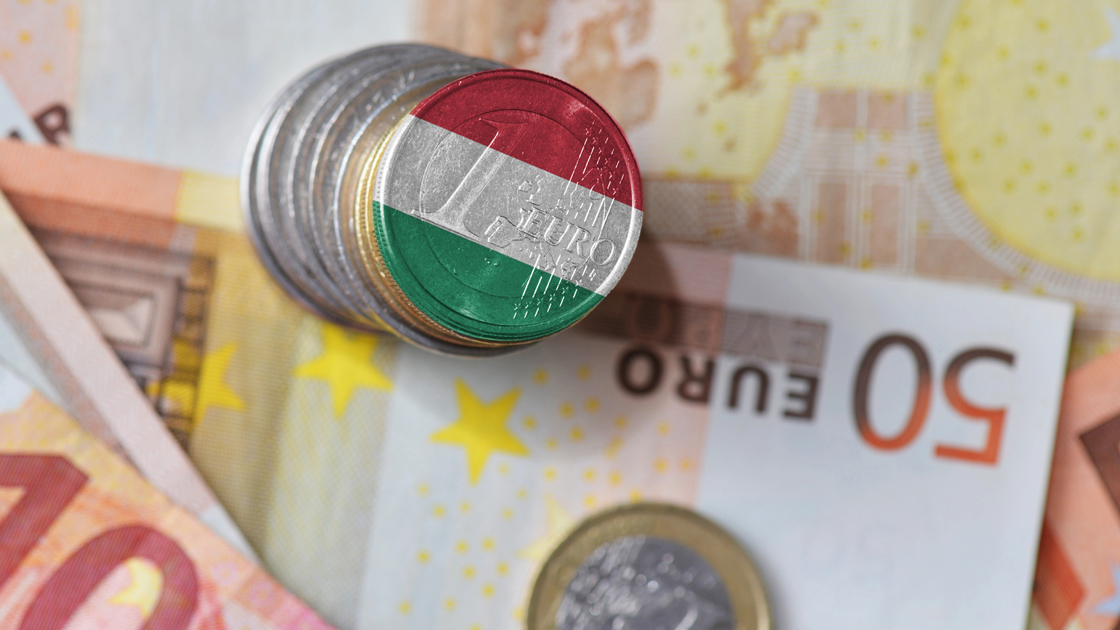

The most important domestic economic “story” of the coming years will be Hungary’s planned adoption of the euro; the economic and financial significance of adopting the common European currency is comparable to Hungary’s accession to the EU in 2004.
The adoption of the euro is a strategic step that fundamentally determines the future framework of the Hungarian economy and reshapes the scope for Hungarian economic policy. Based on market pricing, investors believe in Hungary’s euro adoption, but beyond the Maastricht criteria, there are at least four areas that could cause headaches and therefore deserve particular attention in the coming years: developments in the international and geopolitical environment, the structural challenges of the Hungarian economy, the structure of the budget, and the optimal monetary policy strategy as noted by the GKI Economic Research Institute.
“Hungary is committed to adopting the euro and has undertaken to meet the Maastricht criteria by 2030,” Finance Minister András Kármán announced in June 2026, thereby reaffirming the government’s previously emphasized position on the adoption of the common European currency. The plan to adopt the euro fundamentally determines the medium-term outlook for the Hungarian economy, in two respects: on the one hand, after its introduction, the new currency will affect the Hungarian economy as a whole, while on the other hand, the performance and condition of the Hungarian economy as a whole up until its introduction will affect the success of the adoption.
A stable international environment is needed for a successful euro adoption – and that is precisely what is least available today. Geopolitical tensions and armed conflicts, the polarization of trade and the reorganization of production chains, “post-truth” political uncertainty, the technological and artificial intelligence race, as well as increasingly frequent extreme weather events all work against predictability.
Added to this are high energy prices and rising international yields, which looking ahead point to higher inflation and slower global growth: the price of oil is around 100 dollars, while the yield on the US ten-year government bond, which serves as a benchmark for the whole world, has climbed above 5%, something that has not happened in decades. A euro adoption roadmap is worth only as much as the external environment allows it to be, which is why it is far from irrelevant whether Hungary will be “lucky” in this respect, or whether our ship will somehow have to make it to port through stormy seas.
As regards structural challenges of the Hungarian economy, researchers point out that the common currency requires a competitive economy with a level of real development comparable to that of the Western European countries in the euro area. Between the end of 2022 and 2025, the Hungarian economy practically stagnated, while in the first half of 2026 it recorded growth of 1.7% – at the same time, investment is stagnating, the construction industry is in a steep decline, and agriculture is struggling. The Hungarian economy has become significantly integrated into Western European production chains, particularly with regard to the German automotive industry.
At the same time, there are deeper, structural problems: the extensive growth model that has driven Hungarian growth up to now has run its course, productivity is increasing only modestly, while wages have risen significantly. The transition to a knowledge-based economy is lagging behind, low value-added production continues to account for a large share of the economy, energy intensity is high, and procurement is concentrated – making the Hungarian economy vulnerable. Meanwhile, the defense industry, environmental protection, the green transition and the human services sectors are creating significant investment needs. The labor market is likewise facing a number of challenges (skills, mobility, flexibility) that could, where applicable, constitute country-specific problems.
A credible euro plan requires credible fiscal consolidation. The government’s declared goal is “deficit reduction through economic growth”; the approach is expenditure-side and relies on credibility, external sources, and private-sector lending picking up as a result of monetary easing.
One of the most important elements of consolidation could be cheaper debt management: according to an earlier estimate, interest savings could accumulate to as much as HUF 2,400 billion over four years. Rising yields, however, work in the opposite direction, while the share of foreign investors is increasing – it remains an open question how speculative this is, and how sensitive these investors are to the “euro story.”
The fourth condition is achieving price stability on a sustainable basis. Inflation is currently the only Maastricht criterion that is being met, and inflation expectations are also declining – yet the picture is still not without problems.
On the one hand, plenty of hidden inflationary pressures remain, in the form of postponed investments (for example, in the water system) and remaining price controls. On the other hand, the current low-inflation environment comes at a significant cost: the central bank is currently maintaining a real interest rate of 300–400 basis points (compared with 0–50 basis points in Germany), which has resulted in a strong exchange rate and, consequently, rapid real appreciation.
What is needed is not a fast, but a successful euro. Timing and allowing for real economic adjustment (i.e. the speed of the processes) matter at least as much as the intention itself – while choosing the conversion exchange rate will in itself be a key issue.
The above four pillars are relevant not separately, but together and simultaneously, alongside the nominal Maastricht convergence criteria. The potential benefits are real, the market is optimistic, and public support is high. Yet the stakes lie in ensuring that Hungary does not merely “force its way” into the euro area, but achieves a certain state: a competitive, balanced economy that remains stable within the framework of the euro as well. And this requires not the fastest, but the best-prepared path.


Top 5 Articles
 What Awaits the Hungarian Economy in 2026 and 2027? April 24, 2026
 - Cherishing Italian Cultural Presence in Hungary September 3, 2026
- Consolidating the Good Bilateral Relations May 10, 2026
- Indotek Group Acquires 100% of Auchan Magyarország June 26, 2026
- Two Vantage Points, One Direction August 22, 2026