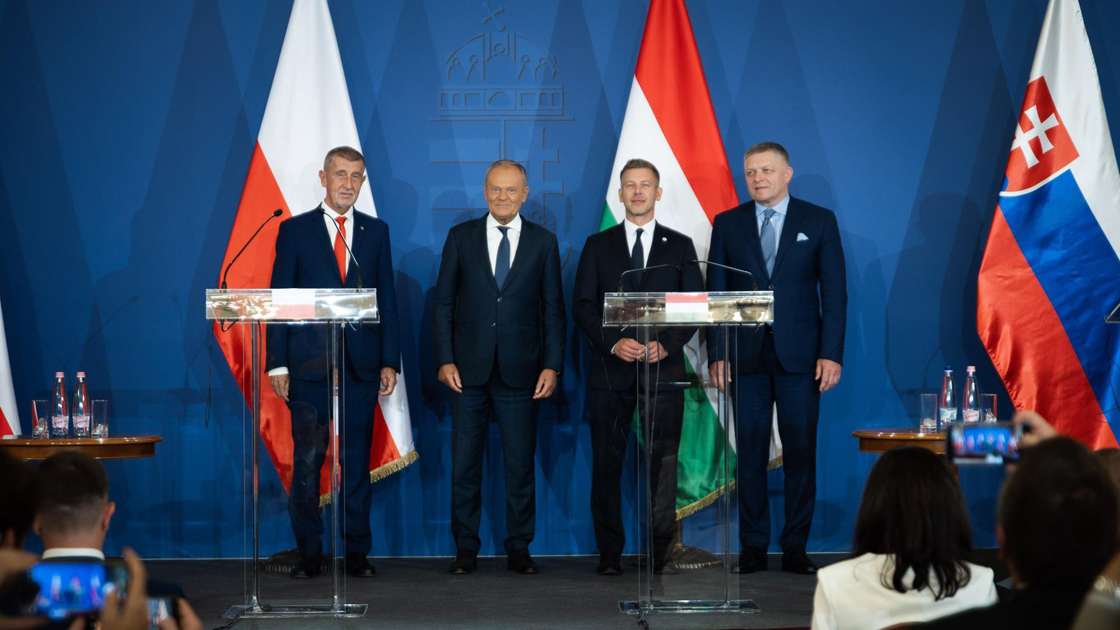

On the 35th anniversary of the Visegrád Declaration, the heads of government of the Czech Republic, Hungary, Poland and Slovakia met at the Royal Palace in Gödöllő, east of Budapest, this week and relaunched the Visegrád Four (V4) partnership among the four countries. Following the Hungarian parliamentary elections in April 2026, with high-level political cooperation restored, the main objective of the Gödöllő summit was to revive political dialogue and identify areas for cooperation, the Hungarian government stated.
It was back in 1991 that Hungary, Poland and the then Czechoslovakia founded the group of states in the northern Hungarian town of Visegrád, which was chosen as the location for the summit as an intentional allusion to the medieval Congress of Visegrád.
35 years later, the meeting this week also served as the closing event of the Hungarian presidency of the Visegrád Group, which runs until June 30, 2026, under the motto ‘Competitive Visegrád’. The topics of the meeting had been agreed upon by the participating heads of government (Czech Prime Minister Andrej Babiš, Slovak Prime Minister Robert Fico, Hungarian Prime Minister Péter Magyar and Polish Prime Minister Donald Tusk) last week at a European Union meeting in Brussels.
According to a statement issued following the summit, the prime ministers of the Visegrád Group have "returned to their roots and agreed to strive for closer cooperation than ever before." They "agreed to strengthen the V4 cooperation, building on shared interests and joint achievements that have already been demonstrated in the past in areas such as joint positions on European Union policies, such as tackling high energy prices and migration."
The prime ministers "also agreed to seek cooperation with regional, European and global partners based on shared interests", the statement said.
The document made a special mention of the European Union's Multiannual Financial Framework, cohesion and agricultural policy, a resilient internal market, sustainable agriculture and food production, merit-based integration of candidate countries, a balance between clean energy and competitiveness, as well as a package concerning the automotive industry and trade policy as areas in which Visegrád countries have shared interests.
Participants in the summit "agreed to ask their relevant ministers and EU chief negotiators to reestablish channels of cooperation in the field of the EU policies in order to reinstate the previously efficient coordination framework of the Visegrád countries," the statement added.
The four heads of government all sounded optimistic following the Gödöllő meeting. At a press conference after the V4 summit, Polish Prime Minister Donald Tusk said "I thank my dear friend Péter Magyar for restoring hope" in the Visegrád Group. "Hungary, too, can once again have a voice at European events, and we can cooperate again despite our differences, because we all know that we do not see eye to eye on every issue," he added.
Czech Prime Minister Andrej Babis stated that "We are once again all in the same boat, and we will fight for the interests of our countries and our region... These four countries are the future of Europe, and I am convinced we will work perfectly together again, as we did in the past."
Slovak Prime Minister Robert Fico told the press conference that boosting competitiveness was one of the main goals of the Visegrád Four's Slovak presidency, which begins on July 1. He added that the four countries wanted to become very strong again.
Hungarian Prime Minister Péter Magyar confirmed that Hungary, the Czech Republic, Poland and Slovakia were committed to strengthening the Visegrád cooperation. He added they wanted to build a V4 that could deliver tangible results and speak with a strong, credible voice in European decision-making.
As the German conservative newspaper Die Welt noted, it was the Visegrád group's first meeting after Viktor Orbán was voted out of office in Hungary and the summit was expected to bring new momentum to the format. “If this succeeds, the four states could have a greater impact on European politics in the future. But there are still a number of internal conflicts standing in the way,” the paper said.


Top 5 Articles
 Cherishing Italian Cultural Presence in Hungary September 3, 2026
 - Consolidating the Good Bilateral Relations May 10, 2026
- Indotek Group Acquires 100% of Auchan Magyarország June 26, 2026
- Two Vantage Points, One Direction August 22, 2026
- Ágnes Forsthoffer, Interim Hungarian President July 20, 2026