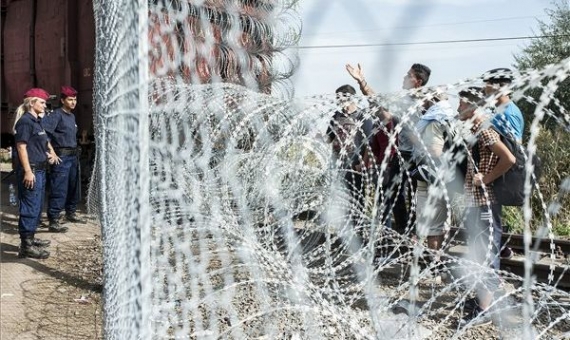

Hungarian police closed an unofficial crossing point along a train track between the Serbian village of Horgos and the Hungarian village of Röszke to stop the influx of illegal immigrants, while the government declared a state of crisis in two southern counties and more police and military forces were deployed along the newly-built fence on the border.
According to government sources, migrants arriving from Serbia may submit their asylum applications at two transit zones: at Röszke and Tompa. This is where their personal details are registered and their fingerprints and photos are taken; this information is then entered in the EU database.
The Hungarian state will provide for the care of people in transit zones. If no decision is taken on an asylum seeker’s application within 24 hours, they are provided with temporary accommodation on the premises.
Applications are assessed by the authorities within eight days at the longest, and an applicant may request a court review of a decision – but no later than two days after a decision has been issued. In the event of refusal, migrants are sent back to Serbia; however, this cannot be regarded as deportation, as in a legal sense applicants are not on Hungarian territory when they are within the transit zone. Migrants in the transit zone are not in custody, and are free to leave at any time – but towards Serbia only.


Top 5 Articles
 What Awaits the Hungarian Economy in 2026 and 2027? April 24, 2026
 - Cherishing Italian Cultural Presence in Hungary September 3, 2026
- Consolidating the Good Bilateral Relations May 10, 2026
- Two Vantage Points, One Direction August 22, 2026
- Business, Consumer Confidence at Two-Year High in April April 23, 2026